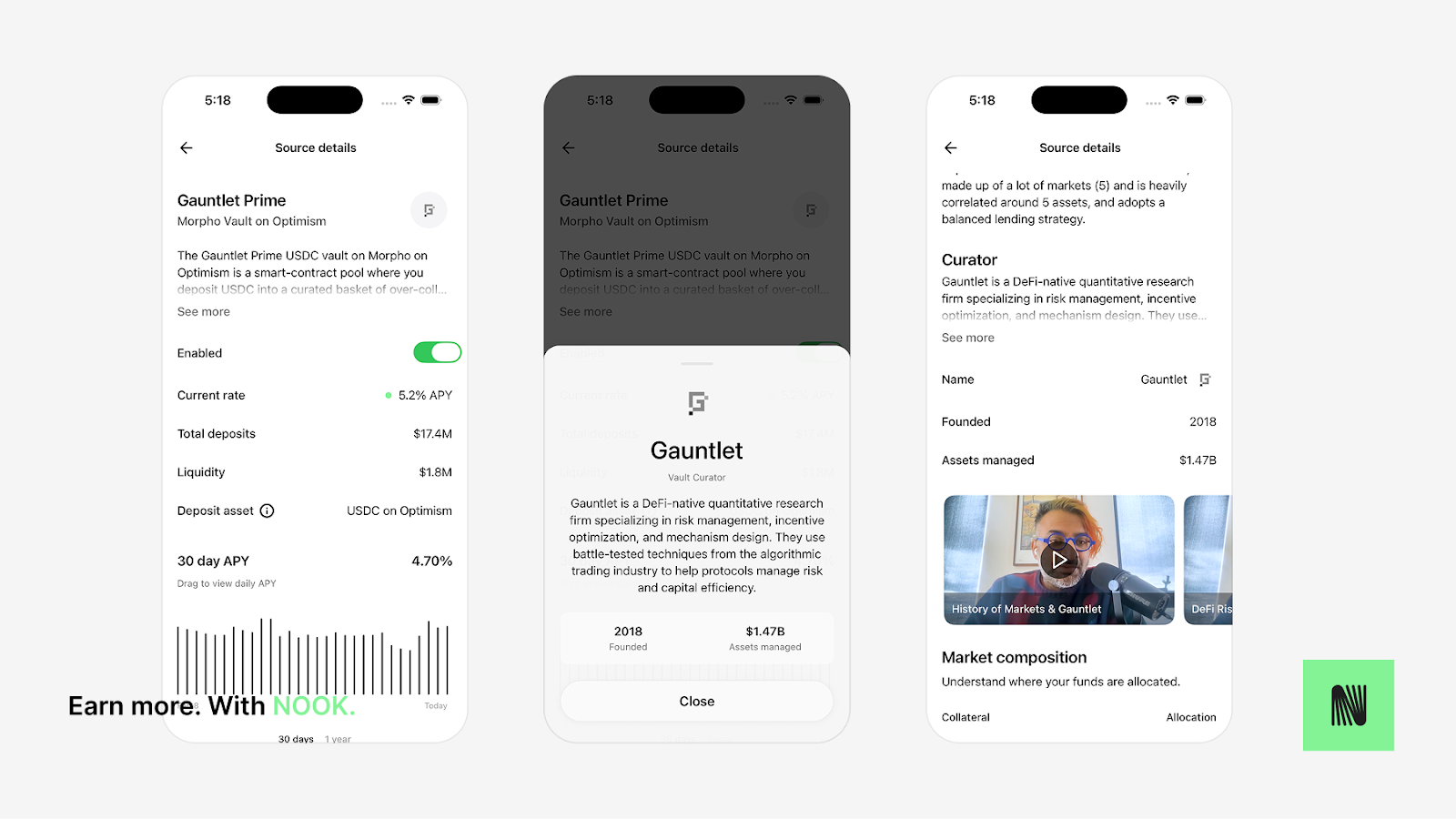
# Welcome to Nook
Nook is on a mission to bring higher earnings to everyone.
We started Nook to close the gap between how high earners and everyday people save.
### Higher earnings, powered by open markets, not middlemen
With over $60B+ in deposits to our partner markets and 100M+Transactions through Nook, Nook is growing to be a part of the finances industry shift towards stablecoins. The markets we tap into are autonomous software that match lenders and borrowers directly. With rules written in code, there’s no bank in the middle.
Safety comes from over‑collateralization: borrowers lock up more value than they borrow. If their collateral falls, the Market sells it automatically so lenders are protected.
Borrowers use Markets for everyday spending without selling appreciated assets, to access new opportunities without disrupting portfolios, and to arbitrage price differences across venues.
Nook is currently available only in the U.S for [download on iOS](https://apps.apple.com/us/app/nook-savings-app/id6742204281)
### Next
In the basics, we will walk you through some of the questions and key information frequently asked about Nook.
# How Earning through Nook Works
A breakdown of how we connect you to money markets in 3 key steps.
Think of Nook as a high-yield earning account that taps into the stablecoin lending markets. When you deposit money, whether through Plaid Coinbase, Apple Pay, or a debit card - your funds are put into a programatic money market, where they are automatically matched with borrowers. These borrowers have collateralized their funds so that they are yours until they repay their borrowed amount.
The interest from Nook comes from the interest paid by borrowers and goes directly to you. Nook does not take a cut or a fee.
The earning process can be deposited into three key steps.
#### Convert your cash
Nook partners with Coinbase - our trusted payment provider - to convert your funds into USDC, a stablecoin pegged 1:1 to the U.S. dollar.
The conversion happens behind the scenes in seconds, so you can start earning right away.
#### Deposit your funds
Nook sends funds from your wallet directly to the earning protocol with the highest rate — all of which are hand selected with over $60B total across their platforms.
#### Withdraw your funds
You can initiatie a withdraw your funds directly back to your Bank or Coinbase account at any time. There are no lockups, delays or wait times put in place by Nook. Our customers earn for varied periods of times. Typically over months, but sometimes, shorter durations.
Since interest is paid out every 16 seconds, users can move funds in and out of Nook as they please. This is not a fixed bond or CD.
# How Nook earns Higher Rates
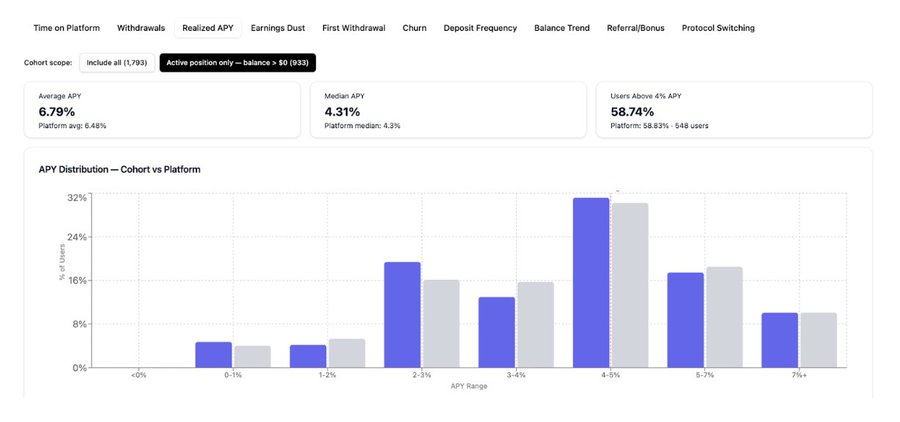
Let's explore how Nook averaged 7.6% APY in 2025
Nook taps into money markets where the rates are set by supply and demand.
If demand for funds (USDC) is high, then the rate of return is high. This is all calculated automatically based on (a) money deposited and (2) money borrowed.
Nook currently connects you to one of five earning markets, from two protocols including AAVE and Morpho, with over $60B in asset deposits between the three.
Rates are not always high however and tend to see decreased returns in slower markets.
**Why do people borrow funds against their existing assets onchain?**
People borrow funds against their existing assets for different reasons.
But people often need access to liquidity for trading or tax benefits - and they’re willing to pay higher rates for that convenience. If the borrower is unable to repay the loan, the protocol automatically liquidates the borrower’s collateral to repay the loan.
That’s the beauty of collateralized lending: the system is designed to protect lenders (you) and the borrowers assume the risk.
# Moving across sources
Rebalancing is a key part of ensuring that you earn the highest rate over time.
Nook customers can earn through over nine money markets. These markets are based on stablecoin yields, and their rates are always changing (based on market supply and demand as covered in [How Nook earns Higher Rates](/overview/editor-1).
Over the past year, the four markets (Seamless Morpho Vault, AAVE Core and Spark Morpho Vault) have averaged 8.3%, 7.2% and 5.4%, APY, respectively. So it might seem obvious to just go with the highest earning market. Not exactly.
If we look closer into the details, having a range of five plus options to automate across has actually resulted in a 14.5% increase in earning rates. From an average of 8.3% → 9.5% APY over the past 365 days.
### Moving from one source to another
Moving from one earning source to another is designed to be simple, fast, and free. It starts with USDC. You can deposit straight from your bank into USDC, then allocate from there with an internal transfer.
From USDC, you can choose any Core or Frontier earning source available in Nook. You can also transfer funds directly from an existing earning source, including USDC, Core, or Frontier. Want to move from a Core source to a Frontier source? You can. Want to move from Frontier back to Core? You can do that too. Transfers within Nook typically take anywhere from 2 seconds to 20 minutes, depending on the source and network you select.
You choose where your funds earn Nook. Allocation is in your hands. You can choose whether to move part of your balance or your full balance. You can decide which source you want to earn in, when you want to move, and how much you want to allocate. There are no transfer costs or fees across any supported source or network, including Base, Ethereum mainnet, Optimism, and World.
To date, as part of these rebalances, Nook has processed over $100M in successful transactions through the platform. Paving the way to $1B in transactions.
# Withdrawing from Nook
Transfers out of Nook are designed to be free and simple
You can send funds straight back to your bank, wallet or Coinbase account from any source you are earning in.
Nook handles the movement from the earning source back to USDC, then out through the withdrawal method you select. Free and fast. The goal is simple: give you more control over where your money earns, without making you deal with the complexity underneath.
When you start a withdrawal, Nook first moves your funds out of the earning source and back into USDC. This means your position is exited, your deposit token is converted back to USDC, and then the withdrawal is sent through the method you choose.
Before the withdrawal is completed, Nook also checks for any pending earnings tied to that source. If earnings are still pending, they may need to finish processing before they are included in the final USDC amount available to withdraw. This helps make sure your withdrawal reflects both your principal and any eligible earnings from the source you were using.
From there, you have three options.
#### Withdraw to bank
Withdraw to your bank If you withdraw to your bank, Nook sends your USDC through Bridge, our payments partner. Bridge converts the USDC back into dollars and sends it to your linked bank account. This lets you move from an earning source back to your bank without needing to manage wallets, exchanges, or stablecoin transfers yourself.
This is an ACH transfer facilitated by Bridge.
Withdraws to bank typically take 1-2 business days as they are processed by Bridge and sent through our partner bank.
#### Withdraw to Coinbase
If you withdraw to Coinbase, Nook sends your USDC directly to your Coinbase account. This is useful if you want to keep your funds in USDC, move them into Coinbase, or manage them from your existing Coinbase account.
#### Withdraw to wallet
If you withdraw to a wallet, Nook sends USDC directly to the wallet address you provide. This gives you direct control of your funds outside of Nook. You can send to a supported wallet and manage the USDC yourself. Nook does not charge withdrawal fees. The goal is simple: give you more control over where your money earns and where it goes next, without making you deal with the complexity underneath.
# How we Secure Your Funds
Security is the first pillar of our approach and fundamental to how we built Nook
#### Security and Risk Management
Security is the first pillar of our approach and fundamental to how we built Nook.
Nook has millions of dollars in deposits and has processed over $500M in transactions. Across our thousands of customers, trust in Nook’s approach to securing funds is paramount. In this post, we go deeper into how Nook approaches security and risk.
### Security
#### How we secure your funds on Nook
We prioritize the security of your assets with multiple layers of protection. Your funds are held in a secure, non-custodial wallet that only you control. Below, we outline the infrastructure we use to secure your funds.
#### Wallet ownership and encryption
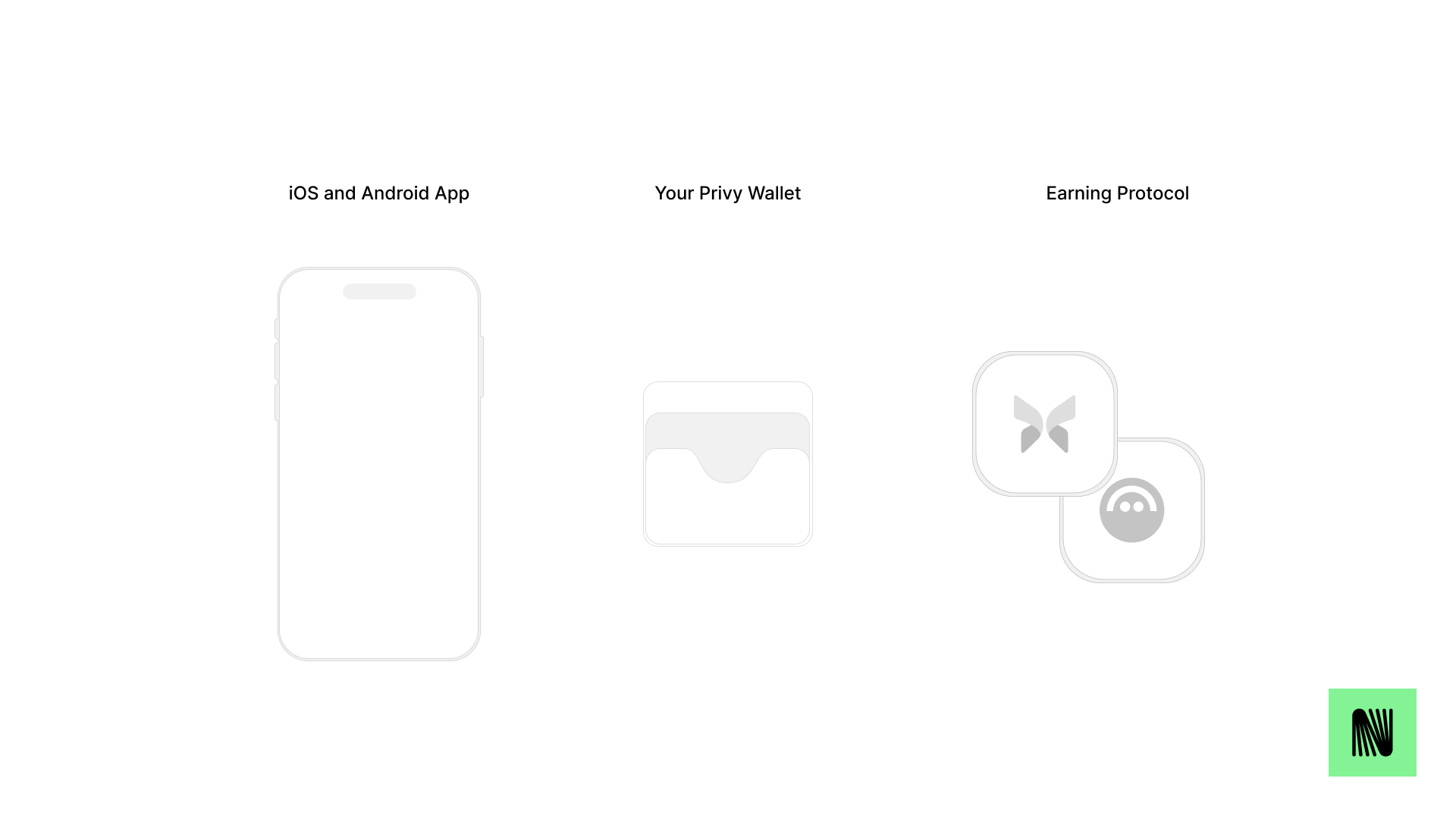
Your funds are secured in a non-custodial wallet that only you control. We use encryption provided by Privy, which supports wallets for over 75 million users. Nook does not store your confidential seed phrase. You always retain control of your wallet.
\
We support two-factor authentication via biometrics, including Face ID on iOS and Android devices.
#### iOS and Android app only
By focusing on the official apps in the Apple App Store and Google Play, Nook cannot be convincingly imitated by a website. We will never ask you to **log in** on a website. This helps prevent phishing—sites that look like ours but aren’t. Using the iOS and Android apps is the most secure way to ensure you’re connecting to the real Nook app.
#### Highest-rated partners
We work with **Stripe** and **Coinbase** to protect your login and identity. By partnering with these world-class providers, we help ensure that your personal information and funds remain secure and private. Stripe and Coinbase have processed over $1 trillion in payments and serve over 100 million customers.
#### Encrypted personal information
At Nook, we do not store your personal information. If Stripe (our banking/KYC partner) requires information such as your date of birth or address, we pass it through securely using encrypted methods and do not store it in our systems. This keeps your information private and secure.
#### Built and operated in the U.S.
We are incorporated in Delaware and headquartered in Austin, Texas.
We do not work with third-party engineering teams outside the U.S., helping us maintain strong compliance and data security standards.
# Risks and Considerations
Earning through Nook is not risk-free
Earning with Nook comes with risks from the underlying DeFi protocols and stablecoins it integrates with (smart contract bugs, depegging, liquidity issues.) To date, there have not been any smart contract bugs, hacks or issues with any of the selected pools.
To mitigate this risk, Nook only partners with the highest rated money markets in the industry, based on their volume, 3rd party smart contract audits, time in market and more.
Disclaimer: Nook is a technology platform and is not a bank or a broker-dealer. Funds deposited through Nook are **not FDIC insured** and may be subject to risk, including loss of principal. Any rates or earnings mentioned are variable, not guaranteed, and subject to change. Nothing on this site constitutes financial, investment, legal, or tax advice. Consider your objectives and risk tolerance before participating.
# How Nook Classifies DeFi Vaults: Core & Frontier
A Risk Framework for DeFi Lending Vaults
by [Krzysztof Gogol, PhD](https://www.linkedin.com/in/krzysztofgogol/) and [Joey Isaacson](https://www.linkedin.com/in/joeisaacson/), Cofounder of Nook
The hardest problem in DeFi is no longer finding yield, but understanding the risks behind it.
Traditional finance has addressed the challenge of risk assessment with various frameworks and classifications.Asset managers like BlackRock and Franklin Templeton organize their funds into clear categories: cash, investment-grade credit, high-yield bonds, equities, and emerging markets. These categories do not guarantee performance, but they give investors a consistent framework for making informed decisions. Investors do not compare Treasury ETFs with emerging-market ETFs solely by annual return - they first ask what risks each product is designed to take.
DeFi has yet to develop such risk frameworks. Today, more than **$60 billion** is deployed across onchain lending vaults. Yet most vault aggregators still present them as a simple list sorted by last week's APY. A relatively low-risk vault can appear next to one financing tokenized complex leveraged strategies with no indication that they represent fundamentally different risk profiles.
Nook was built on a simple principle: yield should always be evaluated in the context of the risks taken to generate it
Every vault listed on Nook is classified as **Core** or **Frontier** based on the risks taken to generate its yield.
Core vaults prioritize capital preservation and consistency, while Frontier vaults pursue higher yields by expanding the range of acceptable collateral, or, depositing assets onto newer networks with smaller markets.
Many curators already signal their intended strategy through names such as Core or Prime for more conservative vaults, and Frontier or High Yield for strategies targeting higher returns.
While these labels provide a **useful starting point**, they are not our conclusion.
Every vault undergoes independent due diligence and is constantly evaluated using Nook's own risk framework. In this article, we explain the principles behind that framework, how we distinguish between Core and Frontier vaults, and why some vaults earn a place on Nook while others do not.
***
#### USDC as the Default
The first pre-classification factor that Nook applies to vault selection is the deposit token.
Nook currently lists **only vaults denominated in stablecoins**. By excluding vaults denominated in ETH or BTC, we eliminate currency risk for our lenders. A 5% yield in USDC means a 5% return on US dollar-denominated capital - without any dependence on the price of crypto-currencies.
We constantly evaluate the DeFi stablecoin market and remain open to vaults denominated in stablecoins, as long as their market capitalization exceeds $100mn. Today, as vaults listed by Nook are denominated in USDC. Issued by Circle, USDC is the most widely used stablecoin in DeFi with the highest daily trading volumes.
That said, two USDC-denominated lending vaults can both show 7% APY - one lending against Bitcoin and blue chip tokens, another against tokenized high-yield strategies. Even though the denomination and APY are the same, the risks behind that yield are not. That is where Core and Frontier differentiator comes in.
***
#### Pre-selection of Lending Vaults
We intentionally exclude any vaults that **follow complex and risky strategies**, e.g., highly leveraged trading of digital or real-world assets. These vaults might offer higher APY in certain market conditions, but the risk is disproportionately higher and, in unfavorable market dynamics, might even lead to the loss of invested capital.
Nook specializes in DeFi lending vaults. In traditional finance, banks lend money based on a borrower's credit score, income, and repayment history. For products such as mortgages or personal loans, the bank assesses the borrower's ability to repay and bears the credit risk if the borrower doesn’t repay.
DeFi lending works differently. It is one of the safest categories in onchain finance because it is overcollateralized and pool-based. Instead of relying on credit scores, borrowers deposit digital assets (worth more than the value of the loan) as collateral. If the collateral value falls below a predefined threshold, it is liquidated automatically to repay lenders. In return, borrowers pay continuously accruing interest, which is distributed to lenders.
***
#### Core: Capital Preservation First
Core vaults are the foundation of Nook. They include lending vaults that are focused on **highly liquid**, **battle-tested** collateral (such at ETH or BTC), operated by experienced curator teams with a strong track record. The classification rules are:
* Curator: Managed by a top-tier curator, such as Steakhouse or Gauntlet.
* Vault TVL: The vault must have more than $10 million in user deposits.
* Asset Allocation: No single asset or ecosystem may represent more than 80% of the portfolio, unless the concentrated asset is an approved blue-chip EVM asset.
* Collateral: Only approved blue-chip assets are accepted as collateral.
* Blockchain: The vault must be deployed on Ethereum or Base.
Core vaults are designed for consistency rather than maximum yield. Collateral is limited to established, highly liquid assets - primarily ETH, BTC and their wrappers. Curators have demonstrated experience managing capital through multiple market cycles, including periods of significant stress.
| Vault | Curator | Chain | TVL | APY | Delegation |
| ---------------------- | ---------- | ----- | ------- | ----- | ---------- |
| AAVE V3 - USDC Pool | Aave | Base | $27.2M | 3.20% | Core |
| Gauntlet USDC Prime | Gauntlet | Base | $433.1M | 4.30% | Core |
| Gauntlet USDC Prime V2 | Gauntlet | Base | $88.8M | 4.30% | Core |
| Steakhouse Prime USDC | Steakhouse | Base | $228.0M | 4.10% | Core |
| Spark USDC Vault | Spark DAO | Base | $7.8M | 3.80% | Core |
In these vaults yield derives from real borrowing demand rather than temporary incentive programs, making 4-5% APY on USDC sustainable. Core vaults earn less compared to high-yield ones because of their very low risk approach.
***
#### Frontier: Higher Yield for Investors Who Understand the Trade-Off
Frontier vaults offer higher yields, often above 7% APY. The reason is that borrowers are willing to pay higher interest rates to borrow against assets that Core vaults typically avoid. This creates higher returns for lenders, but only if the additional risks are properly understood and managed. Nook classifies Frontier vaults based on the following criteria:
* Curator: Newer or non-blue-chip curators may qualify. However, Nook never includes weak, suspicious, or unsupported curators.
* Vault TVL: Each vault must have at least $100,000 in user deposits.
* Assets and Allocation: Any asset and any allocation percentage may be included, provided they pass Nook's strict internal due diligence and review process.
* Blockchain: Vaults on any blockchain may qualify.
#### Current Frontier Vaults
| Vault | Curator | Chain | TVL | APY | Classification |
| -------------------------- | ---------- | ---------- | ------ | ----- | -------------- |
| Gauntlet USDC Prime | Gauntlet | Optimism | $3.3M | 6.30% | Frontier |
| Waterline Reservoir USDC | Waterline | Ethereum | $22.8M | 5.60% | Frontier |
| Steakhouse High Yield USDC | Steakhouse | Base | $28.0M | 7.10% | Frontier |
| Re7 USDC | Re7 | Worldchain | $11.6M | 5.70% | Frontier |
While Core vaults lend against blue-chip collaterals (mostly BTC and ETH), Frontier vaults extend the collateral range. They include wrapped tokens of less liquid tokens (e.g.,SOL, XRP, and ADA), tokenized real-world assets (e.g.,private credit strategies) and lending markets on newer blockchain ecosystems where liquidity is still developing. The evaluation of Frontier vaults is more demanding, and the ongoing monitoring is more intensive, as the major risks often stem from the underlying composition of collateral tokens.
Nook currently lists four Frontier vaults, each generating higher yield through a different source of risk. Steakhouse High Yield USDC expands beyond ETH and BTC by accepting tokens such as SOL, XRP, and ADA as collateral. Gauntlet USDC Prime and Re7 USDC operate on Optimism and World Chain, respectively-ecosystems that are smaller than Ethereum or Base. Finally, Waterline Reservoir USDC earns additional yield through exposure to Reservoir, a yield-bearing stablecoin strategy.
Gauntlet has recently announced that its Frontier vaults will expand to include a broader range of tokenized assets, increasing RWA exposure to drive additional yield for lenders, without exposing them to excessive risks.
#### Overview: Core vs Frontier Criteria
| Criteria | Core | Frontier |
| ------------------------- | ------------------------------------------------------------------------------------------------------ | ---------------------------------------------------------- |
| Curator | Top-tier curator with a strong track record | Newer or non-blue-chip curator, subject to due diligence |
| Minimum vault TVL | More than $10 million | At least $100,000 |
| Collateral and allocation | Approved blue-chip collateral; no asset or ecosystem exceeds 80%, except approved blue-chip EVM assets | Any asset and allocation may qualify after internal review |
| Blockchain | Ethereum or Base | Newer blockchains |
| Typical APY | 4–5% | 7% or higher |
***
#### How Every Vault Earns Its Place
Every vault that Nook reviews is assessed across five areas before it receives a classification - or before it is listed at all.
**Diversification.** Is the vault's exposure spread across genuinely uncorrelated markets, or it concentrates in linked assets? For example, a stablecoin and its yield-bearing wrapper are prone to the same ecosystem risk.
**Collateral quality.** Can the accepted collateral token actually be sold during market stress? Assets like ETH and BTC can absorb sharp price drops and still support clean liquidations of bad debt. Thinly traded tokens or illiquid products, if liquidation fails, can lead to capital loss for lenders.
**Liquidity.** What is the vault's utilization, and does the interest rate curve correct elevated utilization before it becomes a withdrawal problem? A vault that lends at 95% of liquidity has only 5% of its capital available for immediate lender withdrawals.
**Sustainable yield.** Where does the yield actually come from? If the presented APY depends on external token rewards or protocol incentives, it will decline when those programs end.
**Curator track record.** Has the team managed this vault through a market stress event with proven outcomes?
A vault can fail on any one of these and not be listed - regardless of how attractive the APY looks.
A vault's classification is not permanent. Market conditions evolve, curator strategies shift, and what qualifies as Core today may not qualify six months from now.
After the MainStreet USD event in June 2026, several curators with exposure to yield-bearing stablecoins tightened their collateral allowlists - raising LTV requirements, reducing supply caps, or removing certain assets entirely. Others moved in the opposite direction, increasing RWA allocations as tokenized credit markets developed more liquidity.
Nook reviews classifications continuously, and we reserve the right to reclassify or delist vaults where the risk profile has shifted in ways that make the original classification no longer accurate.
***
#### Closing Thoughts
As onchain finance continues to grow, understanding risk is becoming just as important as finding yield. Core and Frontier are Nook's way of bringing a risk framework to onchain lending vaults. Our framework helps lenders understand the risks before each vault APY:
**Core vaults** lend against established, highly liquid assets like ETH and BTC, managed by curators with proven track records. They are built for depositors who want a consistent, sustainable yield without exposure to collateral complexity or liquidity risk. Expect around 4-5% APY.
**Frontier vaults** expand beyond blue-chip collateral into tokenized real-world assets, yield-bearing stablecoins, and wrapped tokens with smaller market caps. They serve borrowers that Core vaults do not list- which is why they pay higher interest. Expect 7-8% APY, with more intensive monitoring required.
The goal of the Nook framework is not to identify the "best" vault, but to match lenders with a strategy that reflects their objectives and risk tolerance. The best investment decisions begin with understanding risk.
***
Part of the Nook educational series. Read the full series at [nookapp.xyz](https://nookapp.xyz)
Previous post: [What Is a Curator? Two Vaults. Same 7% APY. One Right Answer.](http://blog_what_is_a_curator.md)
# Robinhood has officially launched its own network
Why did Robinhood just launch its own blockchain? We dig into the economics behind payment rails and what it means for open markets.
In the Sunday update we cover the technology and components that power Nook - the **easiest way to earn** on your money through **open lending markets.**
This week - these markets took a major step forward with **Robinhood** launching the Robinhood network.
With over **$800M in DEX transactions** on this network, the Robinhood chain enables Robinhood customers (including those not using the Robinhood app) to interact with their new network.
Today - I want to dive into the fundamentals of what a network is, why Robinhood went through with creating their own - and what it means for you and earning across open markets.
***
#### Why finance is being built on open networks
We have covered it before but it’s always worth revisiting the fundamentals.
A **network** is a **blockchain**, or “chain” that allows people to **transact with one another** without having to meet in person, verify identity or any personal information. The verification process is instead done through through mathematical proofs. If I want to record that I have a large deposit on a network, I can do it with just (1) some code (2) a small fee of less than $0.01.
The fee then goes to developers to automatically verify your transaction and record it in the ledger. A universal receipt book for everyone to read.
Think of a network or a blockchain as an **open record book**. Stock markets, banks, mortgage brokers all have similar record books for their safekeeping - but the key difference is that an **open onchain network** is **visible for everyone** to read.
It can’t be erased, or cancelled or deleted. It’s written out in the open.
These open networks, or blockchains, have now been around for over 10 years.
With over $30 trillion in stablecoin transactions completed onchain in 2025, they are quickly becoming the default way for transactions to be recorded. Including for large banks and financial institutions like **BlackRock**, **JPMorgan** and **Fidelity**. In 2024 **BlackRock** created their own money market fund called BUIDL, because they saw that using an open network could be more efficient than using a custom one.
JPMorgan followed suit and did the same last week. Fidelity launched their own stablecoin on a blockchain. Adopting the same advantages for moving funds from one customer to another.
When a network is open, readable and secure - it becomes a **lower cost alternative** to moving funds. So big companies, banks and financial institutions have found use for it just as much as individuals trading, lending, borrowing and sending money.
This is the foundation of Nook: **Open markets** that large institutions and people like you and I can use and access - all together. At launch, Nook was built on Base network. The blockchain developed by Coinbase, for low cost, high speed transactions. Since then, we have launched new network support including Optimism, Monad and more - to connect funds.
#### Why Robinhood created their own network
If there are already multiple networks and trillions of dollars being processed by these networks, it’s a fair question to ask - *why* do we need **another network?**
Nook already supports multiple fast, inexpensive and scalable networks. So *why* do more players like Robinhood keep entering the space?
I think the important thing to think about is the space and **potential opportunity** at stake. Both are huge.
Today, most of our transactions are dominated by a few key players across Credit and Debit. Credit card companies and rails like **Visa** and **Mastercard** alone make up roughly **90% of all transactions across the globe**. **$27 trillion** in **transactions per year**. As for debit transactions - ACH and wire transfers from bank accounts to bank accounts, there are only a handful of companies there as well that control it.
The financial rails of today as we know them are controlled by **just a few companies**.
And we as consumers pay (a lot) to use them. In 2025, Visa, Mastercard and American Express collectively generated **$145B in revenue**. **$103B** from **transaction fees**. That’s **0.3% of the American economy.**
These companies are **massive** because customers and or merchants, on average, get charged 2.35% of each credit card and 0.73% of each debit card transaction. We live in a world where companies are making billions of dollars per year - in a sector of the economy that is valued in the trillions of dollars. So replacing this system is hyper competitive because it’s potentially ***hyper***** lucrative.**
So it was only a matter of time before Robinhood started to take control of their own destiny with their own network.
With Robinhood’s new network, they can do two major things: **save money in new ways** and **make money in new ways**.
The first and most straightforward way is the **money they are saving**. The fees I mentioned earlier to run an onchain network are low, but they are not nothing. In 2025, the Ethereum chain generated **$715M in revenue**. Base chain, the chain created by Coinbase, **generated $75M in revenue**.
If Robinhood can build their own network, **they can decide** what is charged and save money by not paying another company. Especially another competitor.
The second reason is that they can **design the network** for their **customer needs**. Different networks prioritize different actions.
Speed of trade finality for example is one. Agentic trading to support bots is another. There are many tradeoffs when designing a network between speed, cost, scale and more. Visa is focused on speed and scale for example and protecting businesses. American Express is known for very lenient clawbacks. There are tradeoffs and you can’t make everyone happy. But by **creating their own network**, Robinhood can make their **27.7 million customers** happy.
Providing them with lower cost (or free) transactions, that are still fast and simple. Instead of using someone else’s roads - **they decided to pave their own.**
#### Where Nook fits in
As more networks are created by companies like Robinhood and Coinbase as the competition heats up - **Nook sits in the middle of this** - **earning** where the **demand for your money is.**
We are not seeing a high earning rate on the Robinhood chain, *yet*. But we *are* watching it closely. And if (or when) lending on the Robinhood network were to make sense, Nook will unlock access to the Robinhood network and any open network.
But currently the rate on Robinhood chain is 2.1%, **4x less than the current highest rate available through Nook** - if it were higher, it would be live.
So if we zoom back out, it's all part of the broader trend: the world is moving towards transacting, including earning, across open markets. We built Nook **for you to benefit from that**. So even though Robinhood chain is not yet a good fit for Nook, we report on this because it's still a part of the evolution of this industry and the markets you earn from. The more networks and competition - the better.
So that's why, when Robinhood launches a new network - we see it as a positive.
Thank you for being a part of Nook and this shift.
Joey
Cofounder. CEO of Nook.
# Your Bank Is Keeping the Yield
The cost of intermediating a dollar of credit in DeFi is one to two orders of magnitude lower than in TradFi.
by [Krzysztof Gogol, PHD](https://www.linkedin.com/in/krzysztofgogol/)
For decades, banks have generated profits by deploying customer deposits across mortgages, securities, business loans, and other treasury operations. Depositors to savings accounts receive a small portion of that yield back. The rest remains within the banking system, contributing $295.6B in net income that financial institutions generate each year \[1].
Lending your cash through stablecoins and Decentralized Finance (DeFi) changes that equation. For the first time, credit and trading markets can operate directly on blockchain without traditional financial intermediaries sitting between lenders and borrowers.
The cost of intermediating a dollar of credit in DeFi is one to two orders of magnitude lower than in TradFi.
By replacing large parts of the banking stack with automated smart contracts, DeFi lending protocols such as [Aave](https://aave.com) and [Morpho](https://morpho.org) operate with spreads 3x tighter than those of traditional banks.
Thus, conservative DeFi stablecoin vaults today often generate 4-8% APY for lenders. At the same time, banks, which generate returns of roughly 6% on underlying client capital, offer returns of just 0.2-3.2% in traditional savings accounts.
This post explains how DeFi lending works and the five reasons why stablecoin vaults can offer higher returns than those of banking savings accounts.
***
## Primer on Stablecoins and DeFi Lending
Stablecoins are blockchain-based tokens designed to maintain a stable value relative to fiat currencies, most commonly the US dollar. They were introduced to solve one of the key limitations of early digital assets such as Bitcoin or Solana: extreme price volatility.
The two dominant stablecoins today are[ USDC by Circle](https://www.circle.com/usdc?utm_source=chatgpt.com) and[ USDT by Tether](https://tether.to?utm_source=chatgpt.com), with a combined circulation of $272b. They function as the reserve asset and settlement layer of the DeFi ecosystem.
DeFi lending protocols such as[ Aave](https://aave.com?utm_source=chatgpt.com) and[ Morpho](https://morpho.org?utm_source=chatgpt.com) operate through smart contracts (computer programs) deployed on blockchain networks.
* Instead of a bank deciding who receives a loan and at what rate, lending rules are encoded directly into a smart contract.
* Depositors provide stablecoins such as USDC into lending markets or curated vaults. Borrowers access this liquidity by posting collateral, typically digital assets such as ETH or BTC.
* Interest rates adjust automatically according to supply and demand. When borrowing demand rises and liquidity becomes scarce, rates move higher. When utilization falls, rates decline.
The result is a continuously operating lending market with over $60b assets that functions without a traditional banking intermediary in the middle.
***
### 5 Reasons DeFi Lending Pays More Than Savings Accounts
### 1. Banks Keep the Spread
A savings account is effectively unsecured lending to a bank. Depositors provide capital and the bank deploys that capital across loans, securities, and treasury operations. In return, savers receive a predefined interest rate while the bank captures the difference between what it earns and what it pays back to depositors.
In the United States, average bank net interest margins are roughly \~3%. In practice, this means that if a saver receives 3% APY, the bank may be earning closer to 6% on the same underlying capital. For example, if a client deposits $100,000, the bank may generate approximately $6,000 annually by deploying that capital across loans, mortgages, and securities, while only \~$3,000 is paid back to the depositor as interest. The remaining spread is retained by the bank.
Thanks to its automation and efficiency, DeFi compresses much of this spread by allowing borrower payments to flow more directly to depositors after relatively small protocol fees are deducted.
| Market | Lending | Borrowing | Spread |
| ----------------------------------------------------- | ------- | ----------------------- | ------ |
| US Bank | 2.8% | 6.1% | 3.3% |
| Aave USDC pool | 3.34% | 4.07% | 0.73% |
|
Morpho USDC pool (with XRP as collateral)
| 4.92% |
5.88%
| 0.96% |
|
Morpho USDC pool FalconXUSDC as collateral)
| 4.91% |
6.04%
| 1.13% |
Table. Example spread across traditional banks and DeFi lending (May 2026)
***
### 2. DeFi Runs Leaner Than Banks
Traditional banks are expensive to run. Branches, departments, headquarters, payment systems, call centers, and payroll costs all consume the yield generated on deposits.
DeFi protocols replace this structure with automated smart contracts running on blockchain. The difference in headcount and cost numbers is dramatic:
* Aave Labs runs the core protocol with roughly 90–130 employees and reported annual operating expenses near $18M against \~$145M in protocol revenue. \[2]
* Morpho Labs operates with fewer than 30 employees and supports a protocol with over $10B in TVL as of April 2026. \[4]
* JPMorgan Chase, by comparison, employed over 317,000 people in 2024 and reported $203.8B in operating expenses for the year. \[3]
The efficiency gap is large. On a per-employee basis, Aave manages roughly $150M–$200M in TVL per Labs employee. JPMorgan manages roughly $13M in assets per employee. Even after adjusting for differences in service scope, the cost of intermediating a dollar of credit in DeFi is one to two orders of magnitude lower than in TradFi.
According to FDIC data, US banks collected $1.24T in gross interest income in 2025. Yet only $504B was paid to lenders. The remaining $738B was operational expenses, necessary to keep the banking stack running. \[1] A DeFi protocol does not incur such operational costs.
DeFi offers higher yields than savings accounts thanks to its efficiency. Even though the pie of borrower interest is the same, the slice taken out by overhead is much smaller. Consequently, the slice that reaches the lenders is much bigger.
***
### 3. DeFi Rates Respond to Real Market Demand
Bank deposit rates are largely determined by internal treasury decisions and central bank policy, particularly interest rates set by the Federal Reserve. As a result, savings account yields move slowly and are only indirectly linked to real-time borrowing demand.
DeFi lending markets are designed differently. Interest rates adjust continuously according to borrowing demand inside the protocol. The rules governing interest rates are encoded into software deployed on the blockchain. When demand increases and available liquidity becomes scarce, rates move higher automatically.
This also means that DeFi interest rates are dynamic, they can fluctuate as new borrowers and lenders enter or leave the market. The signal a depositor receives is the actual price of credit in the market, not a smoothed version of it.
Example borrowing interest rate on the Morpho USDC market with cbBTC as collateral (right) and borrowing interest rate on the Aave USDC pool (left)
***
### 4. The Risks Are Visible
Traditional finance hides much of the underlying lending activity from depositors. Most bank customers have little visibility into how their deposits are deployed or what risks sit on the balance sheet behind their savings account. When that opacity meets a problem, the result tends to surprise everyone, including regulators.
The 2023 US banking crisis is a reference point. Silicon Valley Bank failed on March 10, 2023 with $209B in assets after $42B of deposits exited in a single day and another $100B was staged to leave the next morning. \[5] Signature Bank collapsed two days later. First Republic followed on May 1. Three of the four largest bank failures in US history occurred in less than two months, and lenders had no real-time visibility into the duration mismatch on the SVB balance sheet that caused it.
DeFi lending markets operate with the opposite default. Collateral positions, liquidations, utilization levels, oracle prices, and vault allocations are publicly visible on-chain in real time. Anyone can inspect exactly how capital is being deployed and what assets back the system, without waiting for a quarterly filing.
The work of interpreting that data is done by curators - risk managers who define a vault's lending policy, set collateral caps, and rebalance allocations as conditions change. The curator layer is now a real industry:
* Gauntlet curates roughly $1.2B–$1.4B in DeFi vault TVL across Morpho and other protocols. \[6]
* Steakhouse Financial curates around $1.3B–$1.6B, including the Coinbase USDC lending vault and several institutional vaults. \[6]
* The top four curators — Steakhouse, Gauntlet, MEV Capital, and K3 Capital — controlled roughly 65% of curated TVL as of late 2025. \[6]
* Morpho's curated vault system alone holds approximately $5.8B in TVL, with total protocol TVL crossing $10B by April 2026. \[6]
These curators publish their risk parameters openly: maximum Loan-To-Value (LTV), accepted collateral, oracle sources, supply caps, and liquidation thresholds. A depositor choosing a Steakhouse or Gauntlet vault is choosing a published risk policy, not an opaque balance sheet.
Transparency does not eliminate risk. It changes how risk is understood and priced. In DeFi, the market can see the balance sheet.
Example of risk parameterization in the AUSD lending market using syrupUSDC as collateral. Maximum Loan-To-Value (LTV) is one of the most important parameters in DeFi lending, determining how much users can borrow against deposited collateral.
***
### 5. Higher Yield Comes With Different Risks
DeFi does not eliminate financial risk, but protects lenders through over-collateralization. Instead of relying on KYC and traditional credit underwriting, DeFi protocols require borrowers to post collateral worth more than the loan amount. For example, to borrow $100k in stablecoins, the borrower must deposit ETH tokens worth at least $150k. When the value of these ETH tokens falls below a predefined threshold, e.g., $120k, the loan positions are liquidated to prevent bad debt. In most market conditions, this mechanism effectively protects lenders from borrower default.
The exceptions are exploits and hacking attacks. In extreme scenarios, these events can impair the value of collateral and create losses for lenders. For that reason, risk and collateral management are critical components of DeFi lending and are carried out by qualified curators - risk managers. Their due diligence process includes the evaluation of lending parameters and collateral quality - both from the economic, technical, and governance perspectives.
Unlike bank deposits, DeFi positions are generally not protected by government-backed insurance schemes such as FDIC insurance in the United States. Part of the additional yield in DeFi therefore exists because users are directly bearing risks that banks traditionally absorb on behalf of depositors.
Additional complexity also comes from self-custody and private key management. Newer applications such as [Nook](https://nookapp.xyz/) aim to abstract away much of that operational and due diligence friction.
***
### Closing Thoughts
Conservative DeFi stablecoin vaults today often generate 4–8% APY on USDC, compared to roughly 0.2–3.2% offered by traditional savings accounts.
That difference does not come from “magic internet money”, but is the consequence of removing layers of financial intermediation. Traditional banks retain more than half of gross interest income through the spreads. DeFi allows almost all borrower payments to flow directly back to lenders.
As a trade-off, lenders in DeFi become more directly exposed to risks such as smart contract exploits, hacking attacks or stablecoin de-pegs. DeFi positions are generally not protected by FDIC insurance.
DeFi infrastructure is evolving quickly. Curators like Gauntlet and Steakhouse now manage multi-billion-dollar vaults with published risk policies. Applications such as Nook increasingly abstract away the complexity of wallet management and self-custody.
DeFi is therefore not simply building a "better savings account." It is building a new, transparent, programmable, and market-driven financial system, one that is gradually becoming accessible to mainstream users.
***
### Sources
\[1] FDIC Quarterly Banking Profile (2024 full-year data): total interest income \~$1.24T, interest expense \~$504B, net interest income \~$738B, noninterest income \~$338B, net operating revenue \~$1.08T, industry net income \~$295.6B.
\[2] Aave revenue and operating expense figures: TokenTerminal / Aave DAO reporting via [AMBCrypto coverage of Aave revenue](https://ambcrypto.com/aaves-revenue-surges-despite-dao-turmoil-is-lending-defis-backbone-now/) and [The Block on the Aave Labs / DAO funding proposal](https://www.theblock.co/post/389726/aave-labs-proposes-100-protocol-revenue-dao-exchange-funding).
\[3] [JPMorgan Chase 4Q24 Earnings Press Release](https://www.jpmorganchase.com/content/dam/jpmc/jpmorgan-chase-and-co/investor-relations/documents/quarterly-earnings/2024/4th-quarter/36b3c0a4-3ecd-422e-8167-0a31372f3438.pdf) — 2024 full-year noninterest expense of $203.8B.
\[4] Morpho TVL and team size: [Morpho Protocol Explained 2026 — Eco](https://eco.com/support/en/articles/13064566-morpho-protocol-explained-2026); team headcount via [Morpho Labs on PitchBook](https://pitchbook.com/profiles/company/491803-39).
\[5] SVB failure and deposit run figures: [FDIC, "Lessons Learned from the U.S. Regional Bank Failures of 2023"](https://www.fdic.gov/news/speeches/2024/lessons-learned-us-regional-bank-failures-2023); [Brookings on the Fed response](https://www.brookings.edu/articles/what-did-the-fed-do-after-silicon-valley-bank-and-signature-bank-failed/).
\[6] Curator AUM and market share figures: [DefiLlama — Steakhouse Financial](https://defillama.com/protocol/steakhouse-financial); [DefiLlama — Gauntlet](https://defillama.com/protocol/gauntlet); [Lagoon Finance, "The State of Onchain Vaults 2026"](https://lagoon.finance/blog/state-of-onchain-vaults-2026); [defiprime, "The Complete Guide to DeFi Vaults in 2026"](https://defiprime.com/defi-vaults-guide).
\
\
\
\
# A new stablecoin has entered the market
OUSD (Open USD) promises a different revenue structure for it's end users
By Joey Isaacson
Since we started Nook, we built it on a singular stablecoin. USDC by Circle.
But this week, a **new stablecoin OUSD** (Open USD), created by **Stripe** - and backed by major players in finance in tech including **Visa, Stripe, Mastercard, American Express, BlackRock, Google** and more - has entered as a new stablecoin in the market.
Let’s jump into what a new stablecoin means for you and Nook.
#### What is a stablecoin?
As the financial world heads towards automated and open markets, stablecoins (USD) are the key way to interact. A stablecoin is a 1:1 backed asset tied to the US dollar or another currency. When you buy $1 of USDC, **you get a digital token** (USDC) that’s always **worth $1.**
This allows everyone to interact with other markets, while keeping your assets secure and denominated in the correct currency (USD) - including the borrowing and lending markets Nook connects you to. Think of it as a digital dollar. Where it’s worth $1 wherever it is. Whether it is lending, borrowing, saving, trading - USDC is how the currency in which onchain financial markets interact.
Just looking at its adoption is a good measure of trust. USDC is currently the largest US based stablecoin is USDC. Launched in 2018, this is the main stablecoin that powers Nook - and others like Coinbase, Visa and more. To date, there are over $74 billion of USDC deposits. While the company that created Circle, went public last year - sending its valuation to above $50 billion.
With over 24% market share, USDC carries regulatory standing in the US and Europe and deep exchange liquidity - by partnering directly with banks to custody their $74 billion of deposits. And conducting regular, open and public audits through Deloitte. All funds Circle stores to back USDC are visible in an onchain money market for everyone to see.
So with USDC being adopted by mainstream banks and companies like Stripe, Visa and more - why was a new major stablecoin created?
#### What is the opportunity for a new stablecoin?
USDC began with CEO Jeremy Allaire in 2013 as a regulated payments company. The company chose to work with banks, licenses, and regulators instead of trying to route around them. In 2015, Circle became the first stablecoin company to receive New York’s BitLicense, which helped signal that it was willing to operate inside formal financial rules. When Circle launched USDC in 2018 with Coinbase through the Centre consortium, the promise was simple: every USDC would be redeemable 1:1 for a real dollar, backed by reserves, with monthly attestations from Grant Thornton.
Over time, it added more trust layers: clearer reserve disclosures, cash and short-term U.S. Treasury backing, major partners like BNY Mellon and BlackRock, and public support for stablecoin regulation.
Although USDC and Circle **were built on trust** - they were not necessarily built on sharing revenue. Meaning that, of the $70+ billion in deposits they have, and the $2.74 billion dollars of that revenue they generated from deposits to USDC - not all of it goes back to the distributors or customers.
That’s the big rub.
USDC and Circle have been **so dominant**, that OUSD and other competitors are now offering a **lower cost,** fairer **pricing** structure where the customer and distributor of the stablecoins get more of the revenue. If not all.
*"The marquee partner names clearly suggest a real threat to Circle's business,"* Rob Hadick, general partner at venture capital firm Dragonfly, told CoinDesk. He added that Stripe's broad suite of financial products could give the consortium an edge by allowing it to "uniquely undercut Circle's economics."
This new model means increased pressure on Circle. If USDC can be dethroned as the leading US based stablecoin. Either way, we think it’s good for Nook. And you. Let me explain why.
#### Why this is good for Nook
Currently, **Nook is built on USDC only**. The most trusted US based stablecoin. When you deposit your cash onto Nook, it is converted into USDC and then lent out across different open lending markets.
But I expect the introduction of a new stablecoin to be good for a few reasons.
First is that, when a new stablecoin is launched into the markets, there is generally a period of price discovery and utilization in the early days. New markets are created, often including incentives to create these markets, and rates can fluctuate as the market adapts. Take USDC for example. USDC is available across 15 networks - and on Morpho alone, there are **44 USDC based lending markets**, ranging from 1.1% APY to 11.1% APY.
A lot of that is driven by the collateral assets people are borrowing against. But another factor is the demand for USDC across pockets of the financial world.
For example, if I am a borrower of USDC on the Optimism network, which is more rare, then the rate that I pay as a borrower might be higher than most other networks. Let’s say, 7% or 8% APR vs 3% or 4%. As a new stablecoin enters the market - there will be these imbalances, where a borrower wants to borrow the new stablecoin (OUSD) but the availability of the asset is low. Automatically triggering a higher borrow rate (APR) and therefore a higher rate for you, the lender.
Second, we think more companies like Google, Stripe, Blackrock and more **grow the pie**. More institutions **using stablecoins** builds trust in these overall markets. Right now, Nook connects you to markets with over **$50 billion in deposits**. But we think this number could grow by **10x driven by more institutional borrowers coming online** - if it matches the growth of stablecoin adoption (Citi predicts stablecoin supply could grow from roughly **$300B today** to **$1.9T by 2030** in its base case.) I have covered this in the past - but if more firms begin to use and accept stablecoins as payment - more firms will put their assets in these markets to borrow against.
In general, we think **competition** between different markets, providers - and stablecoins - **is good.** It’s why we built Nook to be based on multiple markets: not just one. A way to access markets across the ecosystems, including different protocols, chains and assets.
\[1] USDC supply, market cap and market share figures: StablecoinBeat, stablecoin market cap dashboard; Circle, “Circle Reports First Quarter 2026 Results.”
\[2] Circle annual revenue and reserve income figures: Circle, “Circle Reports Fourth Quarter and Full Fiscal Year 2025 Financial Results”; Circle investor/earnings materials.
\[3] USDC reserve interest and Treasury backing: Circle, “Circle Reports Fourth Quarter and Full Fiscal Year 2025 Financial Results”; Circle USDC reserve reports and attestations.
\[4] USDC adoption, transaction volume and supported networks: Circle, “2025 State of the USDC Economy Report”; Circle, “USDC Circulation Soars 78% Year Over Year.”
\[5] Circle trust history and regulatory positioning: New York Department of Financial Services BitLicense records; Circle company history; Centre Consortium launch materials; Circle and Coinbase USDC launch materials.
\[6] USDC reserve transparency and attestations: Circle USDC reserve reports; Deloitte USDC reserve examination reports; historical Grant Thornton USDC attestations.
\[7] Circle banking and reserve partners: Circle announcements on BNY Mellon and BlackRock; Wall Street Journal reporting on BNY Mellon adding USDC custody, minting, burning and transfer support.
\[8] Stablecoin adoption projections: Citi, “Stablecoins 2030”; Standard Chartered stablecoin market projections.
# What Is a Vault Curator? Two Vaults. Same 7% APY. One Right Answer.
Every DeFi vault publishes a yield. The strategy behind determines how you earn it.
By [Krzysztof Gogol, PHD](https://www.linkedin.com/in/krzysztofgogol/)
Over $10 billion has been deposited into curated lending vaults on Morpho. Vault aggregators list thousands of options.
Many looks nearly identical: denominated in stablecoins and advertising yields from 1% to 12% and beyond. Yet the differences between them are often hidden - buried in collateral choices, concentration limits, and risk parameters that the APY number alone does not reveal.
This is why Nook lists fewer than ten vaults. We include only those where the risks taken to generate yield are proportionate to the expected return. The difference between a vault we list and one we do not originates not just from the APY itself, but from the strategy the vault executes and the risks taken to generate that yield.
While investors typically view a vault as a product, the most important component is the curator team behind it. The curator is the team that designs the investment strategy, determines the acceptable level of risk, and continuously manages the vault composition. A lending vault may generate yield by lending USDC against ETH, BTC, tokenized Treasury bills, or other digital assets. The vault's strategy and its curator are the two most important variables in DeFi vault investing.
In this post, we explain how to evaluate vault strategies and the curators responsible for managing them.
***
### A Vault Is Only as Good as the Curator Behind Its Strategy
A vault functions like a simple product: lenders deposit capital and earn yield. Behind the scenes, however, it operates an automated strategy to allocate capital across lending markets. Two vaults can be built on the same protocol, accept the same stablecoin, and display the same APY while exposing lenders to very different risk. These risks stem mostly from the market conditions, but can be mitigated with the governance processes set up by the curators.
Examples of strategies: lend USDC against ETH and BTC, lend against tokenized Treasury bills, lend against high-yield digital assets, or a combination with defined allocation limits per market. The strategy determines both the expected return, its sustainability, liquidity profile and the risks involved. The curator is the team that designs, executes and adjusts this strategy.
Consider a lender depositing $10,000 into a vault displaying a 7% APY. Based on that figure, one may expect to earn $700 over the next year. In DeFi, rates change continuously - a vault paying 7% today may pay only 2% next month if borrowing demand declines (the displayed APY reflects the average from the last seven days, not a guaranteed forward rate). In such scenario, a good curator would re-allocate vault capital from the 2% market to market with higher yield within the the vault risk profile. Consequently, the actual return on a $10,000 investment may not differ significantly from the expected $700.
How Your USDC Generates Yield. When you deposit USDC into a vault, the capital flows into individual lending markets according to the vault's strategy:
Each lending market on Morpho has different interest rate, determined by supply and demand. A USDC-ETH market might offer 4%, USDC-cbBTC 4.2%, and a market backed by higher-yield collateral 6.5%. The vault allocates across these markets according to the curator's strategy and the limits they have set - for example, no more than $10M into any single market. On top of these allocations, curators maintain ca 10% liquidity buffer for lenders withdrawals.
What Curators Control - and What They Don't . A curator does not approve individual loans, but set the rules and conditions (e.g. which collateral types are accepted, at what loan-to-value ratios) It is the lending protocol that enforces those rules automatically and provides loans to borrowers. Any borrower who meets the on-chain criteria can borrow. The curator designs and manages the lending policy; the smart contract executes it.
In practice, a curator's job is to move capital between lending markets and update allocation limits. When a market has become too concentrated or a collateral asset's liquidity has deteriorated, curators reallocate capital, adjust supply caps, or update the allowlist. What they cannot do is unwind a loan that is already open - once a borrower has posted collateral and borrow capital, that position remains until repayment or liquidation. The curator's influence is upstream, before capital enters a market, which is exactly why the upfront evaluation matters as much as the ongoing monitoring. What is more, under any circumstances, the curator does not have the technical possibility to withdraw the lender's capital from the vault.
Two of the prime vaults available through Nook illustrate what a conservative allocation looks like in practice:
|
| Gauntlet Prime USDC | Steakhouse Prime USDC |
| ------------------ | ------------------- | --------------------- |
| Network | Base | Base |
| APY | 4.41% | 4.41% |
| TVL | $426.1M | $263.2M |
| Primary collateral | cbBTC, WETH, cbETH | cbBTC, WETH, wstETH |
Both vaults concentrate most of their allocation in BTC or ETH markets. The APY of 4.41% reflects the conservative collateral choice. Wrapped Bitcoin or ETH, and its liquid staking tokens, are the most liquid assets in DeFi.
Now let’s compare hiegh yield vaults of 7%+ instead.
***
### Where Does the Vault Yield Come From?
The reasons why some vaults pay 7%, or more, while others pay just 4.4%, typically come from one or more of the following:
* Credit Risk - lending against digital assets with lower liquidity or higher volatility yields a higher premium, because the default risk
* Liqudity Risk - lower liquidity buffer to instant withdrawals means more capital can be borrowed earning interest
* Concentration - allocating heavily into a single high-yield market increases returns while reducing diversification
* Temporary Incentives - new protocols sometimes subsidize yields with token rewards that eventually end
Higher APY is rarely free. Understanding the source of a vault's yield is the first step toward evaluating whether the APY is worth the risk.
***
### The Same APY Can Hide Very Different Risks: The Three Curator’s Decisions That Define a Vault
Consider two lending vaults, both on Morpho Base, USDC-denominated, and both presenting 7% APY. The first is Steakhouse High Yield, which generates yield by lending against Coinbase-wrapped tokens - cbXRP, cbSOL, cbADA, and cbDOGE - digital assets with real market presence but materially lower liquidity than BTC or ETH. The second is a pure APY-chasing vault that uses automated bots to rotate capital into market offers the highest rate at any given moment.
Although the difference in vault yields is modest, the vaults' risk profiles are very different. The following factors explain why: collateral, quality, concentration, and utilization.
#### 1. Collateral Quality
The most important decision a curator makes is which digital assets accept as collateral in a vault. ETH and wrapped Bitcoin are large, liquid, and well-understood tokens, a sharp price drop still allows liquidation engines to function and recover the loan before lenders are exposed. Long-tail tokens and yield-bearing assets with limited liquidity are harder to liquidate quickly when prices move against borrowers.
The APY-chasing approach makes this risk concrete. When automated bots rotate capital into whatever token market pays the most today, they will inevitably allocate into assets that offer high rates precisely because they carry elevated risk. During the USR stablecoin hack in early 2026, its lending markets were offering unusually high rates. Bots from yield-optimizing vaults began allocating into them. After USR crashed 97% - from $1.00 to $0.025 - following an exploit, those vaults started publishing post-mortems. The curators who had reviewed USR's governance structure before allocating had flagged the risk and avoided bad debt. The ones relying on automated APY rotation had not.
#### 2. Market Concentration
A well-managed vault spreads exposure across multiple lending markets with no single market dominating the vault. When one market represents 90% or more of a vault's capital, the vault is effectively a single-market bet - a sharp deterioration in that market's collateral, or a sudden exit by its borrowers, can imapct the majority of the vault capital at once. A diversified vault, where no market exceeds 30–40% of total exposure, absorbs individual market stress without systemic impact.
Pure APY-chasing strategies tend toward concentration by design: the bot allocates heavily into whichever market currently pays the most, regardless of how its risk profile compares to others. When conditions in that market change, the vault has limited margin to absorb the shift.
#### 3. Utilization
Utilization is a two-edged sword. Higher utilization means more of the vault's capital is actively earning - which is what drives the yield. Lower utilization means more capital is sitting idle, earning less, but available for immediate withdrawal.
When a lending vault's utilization is very high, most of the deposited capital is out on loan and not immediately available for withdrawal.
A vault at 95% utilization resembles a bank that has lent out almost all of its deposits - everything works smoothly until many depositors want their money back at the same time. A vault with $100M in deposits at 95% utilization has approximately $5M in free liquidity.
If $20M in withdrawal requests arrive during a period of market stress -- precisely the moment when depositors are most likely to want their capital - the vault cannot fulfill them until borrowers repay. A vault at 75% utilization has $25M available immediately.
A well-constructed interest rate curve manages this balance mechanically. As utilization climbs above a target threshold - typically around 90% - the borrowing rate increases steeply, incentivizing repayment and driving utilization back down before a crunch develops. At Nook, we do not list vaults where utilization is routinely elevated to mitigate the liquidity risk.
***
### The Curators Behind Nook's Vaults
The most reliable way to evaluate a curator is not their methodology, but their behavior during the market stress. A curator worth trusting evaluates collateral from economic, technical, and governance perspectives. They maintain diversified exposure with explicit limits on concentration in any single market.
A small number of professional teams have built that track record. Steakhouse Financial and Gauntlet are two of the most established, managing $1.5bnand $0.9bn in vault TVL across Morpho and other protocols,. respectively.. Both curators have operated through significant market stress events, published their risk parameters openly, and maintained records that are auditable on-chain. \[1] Their presence on the Nook platform reflects demonstrated behavior, not just stated methodology.
> "Users come first. Everything else follows. We optimize for solvency and liquidity. In a repo market like Morpho, a lender should never lose principal and should be able to exit freely. Optimizing for risk-adjusted returns is a downstream effect of that. Our objective is not to maximize APY. Our objective is to maximize risk-adjusted returns for depositors."
\- Hannes Detlefsen, Steakhouse Financial
Nook does not manage vaults. Our role is to evaluate whether a curator is executing their stated strategy responsibly, and consequently, the presented vault APY is sustainable and worth the underlying risk.
Strategy design. How is yield generated? What collateral backs the loans? What are the curator’s governance processes and infrastrucutre?
Curator track record. Has the team operated through significant market stress event with documented outcomes?
Collateral quality. Does every accepted collateral type pass review on liquidity, oracle design, and or bridge security architecture?
Concentration limits. No single market above 50% of vault exposure.
Utilization design. Is there a rate curve that corrects utilization above 90%?
The goal is not the highest APY, but the highest risk-adjusted, sustainable return.
***
### Closing Thoughts
Most investors compare APYs. Professional investors compare strategies. Nook evaluates whether the curator is executing that strategy responsibly. Two vaults can display the same 7% APY while exposing investors to very different risks.
The presented vault APY is just the history from the last seven days. The vault strategy and the curator determine what happens over the next twelve months.
DeFi offers real yield opportunities, but capturing them requires understanding both the drives and risks involved. At Nook, we are partnering with top curators, selecting only the vaults where the risk profile is transparent and the track record is real.
Selecting a vault is, in practice, selecting a risk management team. The vault's APY is a snapshot of 7-day performance. The curator's decisions determine whether this APY is sustainable.
Coming next: In the next post, we examine five red flags that separate a sustainable APY from a yield trap - and how to spot them before you deposit.
New to vaults?
Start with the previous post in this series: [What Is a Vault? The $30 Trillion Idea DeFi Borrowed From Vanguard](http://blog_what_is_a_vault.md)
***
### Sources
\[1] Curator AUM and market share figures: DefiLlama — Steakhouse Financial; DefiLlama — Gauntlet; Lagoon Finance, "The State of Onchain Vaults 2026"; defiprime, "The Complete Guide to DeFi Vaults in 2026."
\[2] Resolv USR exploit: Chainalysis, "Lessons from the Resolv Hack"; Bitcoin.com News, "Resolv Labs Pauses Protocol After $23M Exploit Triggers USR Stablecoin Depeg."
# What Is a Vault? The $30 Trillion Idea, Borrowed From Vanguard
ETFs democratized equity investing. Vaults are bringing the same principle to stablecoin lending.
by [Krzysztof Gogol, PHD](https://www.linkedin.com/in/krzysztofgogol/)
In 1976, Vanguard launched the first index fund available to retail investors. The premise was straightforward: democratise access to diversified equity investing. Before Vanguard, investors had two options. They could select individual stocks themselves - a process that required a brokerage account, significant capital, and the ability to research hundreds of companies. Or they could pay an actively managed mutual fund to do it for them, at annual fees of 1–2%, with most of those funds still underperforming the market.
For the vast majority of people, meaningful participation in equity markets **was either inaccessible** or **prohibitively expensive**. Vanguard changed that by indexing the entire market at a fraction of the cost - and making diversified investing something anyone could do.
Today, ETFs and mutual funds hold more than **$30 trillion globally.**
DeFi in 2026 presents the **same structural challenge at a different scale**. With thousands of vaults across Morpho, Aave, Euler, and Spark - each backed by different digital assets, each with different risk parameters - evaluating the opportunity requires the kind of continuous monitoring and expertise that most investors neither have nor need to develop. The yield, however, is real: **conservative stablecoin vaults currently generate 5–7% APY** and are available **Nook**, compared to 0.04% in a Bank of America savings account.
That is 1**0 to 20 times the return** on traditional cash savings - a difference that compounds significantly over time.
A DeFi vault is the answer to the digital asset complexity. It pools capital from investors and deploys it according to a defined lending strategy. The vault curator handles allocation, monitoring, and rebalancing on behalf of lenders. Over $10B in assets is now deposited in curated lending vaults on Morpho alone. \[1] That capital was allocated to DeFi vaults because the yield difference with banks, measured in actual dollars over time, is too large to ignore.
### What Exactly Is a Vault?
A vault is a smart contract - a computer program operating on the blockchain - that pools capital from many investors and deploys it according to a predefined strategy. The mechanics of Morpho vaults are straightforward:
* An investor deposits USDC into the vault and receives vault shares representing their ownership.
* The vault allocates that USDC across one or more lending markets according to its strategy.
* Interest earned by those markets accrues back into the vault.
* The investor can withdraw USDC plus earned yield at any time.
Lending markets in DeFi do not work like a peer-to-peer loan, where one lender is matched to one borrower. There is no system waiting to pair your $10,000 deposit with a single borrower who needs exactly $10,000.
Instead, all depositors contribute to a shared liquidity pool, from which borrowers draw the capital. Consequently, the risk of borrower default is mitigated and spread across all pool.
Interest accrues real-time and is distributed proportionally across all lenders. The interset rate is based on how much of the pool is currently borrowed:
* When utilization is high - more of the pool is borrowed - interest rates rise.
* When it falls, rates decline.
The system is entirely automated, governed by the smart contract rather than by any matching engine or counterparty negotiation.
For example, the Steakhouse Prime USDC vault on Morpho - one of the vaults available through Nook - allocates $330mn worth of USDC for loans across multiple collaterals: ETH, BTC, and other digital assets. A lender contributes capital once to a vault and earn 3.8% interest rate. The vault curator continuously handles allocation, monitoring, and risk parametrization.
### Your Assets, Your Control
The important distinction from traditional banking is that the well-structured DeFi vaults are non-custodial. In a bank or a traditional fund, you hand your assets to an institution. You trust that institution to hold them, report accurately, and return when ask.
In a non-custodial vault, the assets remain yours at all times. The vault is a smart contract - a computer program,, published on the blockchain.
When you deposit your stablecoins, the vault contract records your ownership share. When you withdraw, the contract releases your funds directly to your wallet. There is no intermediary controlling your assets.
This structural difference means that even if the company operating the vault interface shuts down, your assets remain accessible through the underlying protocol. The rules enforcing your ownership are written in code, not in a terms-of-service document.
### The Three Main Types of Vaults
DeFi offers various vault types, each with different risks and rewards
#### Lending Vaults
The most common category, and generally the lowest-risk. These vaults lend stablecoins such as USDC to borrowers who post overcollateralized collateral.
Examples available through Nook: the Steakhouse USDC vault and Gauntlet USDC Core vault, both on Morpho. Typical APY range: 4–7%.
The mechanism protecting lenders is overcollateralization - borrowers must post more collateral than they borrow, and positions are automatically liquidated if that buffer is breached. As we covered in our first post, Your Bank Is Keeping the Yield, this is what allows DeFi lending to operate without traditional credit underwriting. In most market conditions, it effectively protects lenders from borrower default.
#### DEX Liquidity Vaults
These vaults provide liquidity to decentralized trading markets rather than lending markets. When traders swap assets on protocols like Uniswap or Aerodrome, they draw on capital provided by these vaults, and liquidity providers earn a share of the trading fees.
Returns can appear attractive, but this category carries a risk that is easy to miss: impermanent loss. When the prices of the deposited assets diverge significantly, the vault's actual returns can be lower than they would have been if the assets had been held. We return to this in the section on APY traps below.
#### Leverage Yield Vaults
These vaults employ more aggressive strategies: leveraged positions, or stacking multiple yield sources simultaneously.
A leveraged vault might borrow USDC, deposit it into a lending market on Morpho or Euler, borrow again against those deposit receipts, and repeat. Each loop amplifies both the yield and the exposure to adverse conditions. APYs can reach double digits. So can the losses when things move in the wrong direction.
### Three Types of Vaults. Very Different Risk Profiles.
Most investors instinctively select the vault with the highest advertised yield. This is often the wrong decision, and sometimes a costly one.
Consider a simple example. An investor with $10,000 offered the following three options:
| Vault | Type | Strategy | Advertised APY | What Actually Happens |
| ---------------------- | --------------- | -------------------------------------------------------------------------------- | -------------- | ------------------------------------------------------------------------------------------ |
|
| 17.73% | A collateral price drop triggers cascading liquidations; months of yield lost in hours |
Vault B is the trap that catches the most investors. DeFi aggregators display the gross fee APY - sometimes 15%, 17%, or higher - without accounting for impermanent loss. The net return, after price divergence is factored in, can easily be negative. An investor who deposited $10,000 expecting $1,700 in annual income could instead finish the year with $9,700.
The published APY reflects what a vault pays when every assumption holds. It says nothing about what happens when they do not.
### The Biggest Mistake: Chasing APY
DeFi currently hosts over 1000 active curated vaults across various categories. They each have different levels of risk, and the advertised APY rarely reflects those differences.
| Type | Typical APY | Main Risk | Nook Offers |
| --------------- | ------------- | ----------------------------------------------- | ----------- |
| Basic Lending | 4–7% | Bad debt, liquidity crunch | ✅ Yes |
| DEX Liquidity | 5–17% (gross) | Impermanent loss can turn positive APY negative | ❌ No |
| Leveraged Yield | 10–25% | Leverage amplifies losses as well as gains | ❌ No |
Out of three vault categories in DeFi, Nook offers only one: lending vaults. This is a deliberate choice, as lending vaults offer attractive, stablecoin-denominated returns with the lowest tail risk of any vault category. Rules governing lending vaults are published on-chain and auditable by anyone. The higher advertised yields in liquidity provision and yield enhancement vaults come with market risks - impermanent loss, leverage exposure - that are easy for investors to underestimate and hard to mitigate.
### The Case for Starting Early: Five Years of Compounding
The yield difference between a savings account and a well-managed vault may seem abstract when measured in one year. Yet across five years, the difference becomes significant.
|
| Bank of America (0.04%) | Vault A — Conservative (5.2%) | Vault B — Nook target (7.6%) |
| ------------ | ----------------------- | ----------------------------- | ---------------------------- |
| Start | $10,000 | $10,000 | $10,000 |
| Year 1 | $10,004 | $10,520 | $10,760 |
| Year 2 | $10,008 | $11,067 | $11,578 |
| Year 3 | $10,012 | $11,642 | $12,458 |
| Year 4 | $10,016 | $12,248 | $13,405 |
| Year 5 | $10,020 | $12,885 | $14,424 |
| Total earned | $20 | $2,885 | $4,424 |
The gap between a savings account and a conservative DeFi lending vault - $2,865 over five years on a $10,000 investment - is significant. It is the difference between a savings account that is barely outrunning inflation and one that meaningfully compounds over time.
Nook provides access to a curated selection of lending vaults - chosen for conservative risk profiles, transparent parameters, and consistent stablecoin-denominated returns. The compounding in the table above is not theoretical: Nook customers have been earning at these rates since the platform launched in June 2025, and have collectively processed[ over $1 billion in transactions](https://docs.nookapp.xyz/updates/milestone-usd1b-in-transactions) across those vaults to date.
### Closing Thoughts
When Vanguard launched the first index fund in 1976, it did not require investors to become stock analysts. It gave them access to a professionally managed, diversified portfolio. ETFs now hold more than $30 trillion globally.
DeFi vaults are following the same trajectory. There are over 1’000 vaults available for investors, falling into one of three categories: lending, liquidity provisions or leverage. Nook offers only one type - lending vaults. This is a deliberate choice, as only these vaults offer sustainable, stablecoin-denominated returns. The higher yields advertised by other categories come with hidden risks that are not reflected in the headline APY.
Over $10B is allocated to leading vaults on Morpho today. That capital did not flow there because investors understood every technical detail of how each market operates. It flowed there because investors found vault strategies they trusted.
The question worth asking before depositing is not: which vault has the highest APY? The better question is: how sustainable this yield is, and who is managing the risk behind it?
Thanks for your time.
Kris.
***
### Sources
\[1] Morpho TVL: Morpho Protocol TVL data via DeFiLlama; total protocol TVL crossing $10B by April 2026.
# The Starter Problem: Invisibility of Yield for Small Balances
I’m Dan, I’m currently an Operations & Engineering Intern at [@nook\_platform](https://x.com/@nook_platform). I’m in charge of special growth projects, ranging from everything from onboarding to customer friction to adoption to payouts. After joining Nook and looking at the experience from the customer lens, I noticed something interesting. In the data I’ve recently analyzed, I discovered a pattern prominent amongst low depositors, leading them to earn less and return less. It made sense from a behavioral standpoint - but was concerned that DeFi payouts, designed for everyone, were not working for everyone as intended.
I dug deeper into the data to look at this problem of users that have less than $500 in their Nook account specifically. Here is the cohort, how I searched it and what I found.
Before diving into the numbers I found, I want to revisit why Nook was built in the first place. Nook was built to give users simple, direct access to higher-yield earning opportunities by abstracting away the complexity of DeFi, while still maintaining transparency and control over where their funds are allocated.
## The Technical Issue
The numbers I found to start were that \~74% of active users hold $500 or less in the app. Together, the low depositor group accounts for about \~$67K out of nearly $10M in AUM present on the app. So the majority of our active users represent less than 1% of capital on the platform.
## These Aren’t New Users
Another key takeaway from this cohort is that most are not new users. The average user in this cohort has been on Nook for about 174 days. Around 73% have been on the platform for between three and twelve months. Only about 7% are truly new.
As mentioned earlier with the pattern I noticed with low depositors earning less and returning, the user balances barely change with time within this cohort. In other words, these are not users steadily building their savings over time. As a result, most deposited once and stopped.
## The First Two Weeks Matter
The next important takeaway was the median time from first deposit to first withdrawal is about \~14.6 days for this cohort. That means the key decision window happens almost immediately. Users deposit, watch for results, and decide whether the product feels worth using.
Among users who are in the cohort, about 46.11% fully exit. Churn in this cohort is about \~46.33%, versus roughly \~34.37% platform-wide.
At the same time, about \~38.72% of users never withdrew at all. That does not mean they are engaged. In many cases, it means they are dormant, not active.
Despite these factors that have contributed towards low depositors earning less and returning less, there’s another key takeaway I have decided to look into for this cohort. A takeaway that showcases a good chunk of our low depositors.
Out of the low depositors, I discovered that \~41% of them earn less than 4% APY. The percentage earning less than 4% APY is already concerning as Nook’s purpose is to provide users direct access to higher-yield earning opportunities.
## Two Different Experiences
After analyzing the low depositor group, I came to the conclusion that there’s clearly two different experiences amongst our users.The two different experiences I notice for a Nook user include:
* For large balance users, Nook works the way people expect a yield product to work. Funds would be allocated across [@Morpho](https://x.com/@Morpho) sources, rewards accrue, claims are processed, yield compounds, and growth becomes visible over time as they use the app.
* For smaller balance users, the system still works. But the output is often too small, too delayed, or too fragmented to feel real.
Because of that, I’ve decided to dive deeper into the user behavior of the users earning less than 4% APY and having under a $500 account balance specifically.
## Why Yield Feels Invisible
When it comes to low APY, it wouldn’t be a fee problem as Nook fundamentally covers gas, bridge, swap, and [@Morpho](https://x.com/@Morpho) vault transition costs. The issue is that yield can be real on paper while still being invisible in practice. From my analysis, these users would fall victim into these three categories. The categories being the factors that would result in low APY for these users:
* First, some rewards are always in transit. [@merkl\_xyz](https://x.com/@merkl_xyz) rewards go through a verification period before they become claimable, which creates a built-in lag.
* Second, Nook’s daily claim process skips individual token rewards below $0.30. For larger balances this is trivial. For smaller balances, rewards often accrue in cents across multiple tokens and may take days or weeks to cross the threshold.
* Third, even after rewards are claimed, there is still a delay before they are swapped to USDC and deposited back into a user’s position.
In context, all of these fixed-dollar frictions hit small balances much harder than large ones. A stuck $0.30 reward is basically irrelevant for a user with $10,000. For a user with $15, it represents 2% of their position.
Another key takeaway is that this same pattern also shows up with rebalancing, as it is designed to improve returns by moving funds to better opportunities. For larger balances, that works well.
Additionally for smaller balances, rebalancing often leads to frequent cross-chain [@Morpho](https://x.com/@Morpho) vault switches. When that happens, unclaimed rewards on the original chain can be left behind as dust. A few dollars of orphaned rewards is noise for a large account, but meaningful for a user with $40 or $50 deposited. Most of these amounts fall below the $0.30 claim threshold, meaning they are unlikely to ever be claimed.
This issue alone already happens to 71.8% of people within this cohort. This makes the issue more prominent and highlights the need to adjust how rebalancing is handled.
Already enough, the average dust per [@Morpho](https://x.com/@Morpho) vault switcher is about $0.32 which already takes up a good portion into a low balance user’s earnings.
## What We’re Changing
This is the core takeaway as the same system creates very different outcomes depending on balance.The good news is that this is fixable. The yield engine does not need to be rebuilt. The product needs to be tuned for scale.That means improving:
* How rewards are surfaced and delivered for small users.
* Creating a smarter rebalancing system where it would only rebalance more often once the user achieves or deposits a higher balance within their Nook account.
* Being more careful about early rebalancing for new or low-balance users.
* Reducing pipeline lag and making reward timing more legible.
In conclusion, this is not a product pivot. It is an engineering and product design adjustment that would solve the issue with the \~41% of low balance users that earn less than 4% APY. Low APY shouldn’t be the main reason for a user to fully exit the app. Everyone should be able to meaningfully participate in earning, not just users with larger balances.
# Big tech enters the Stablecoin Space
We were always excited for the evolution of the stablecoin space. But the **recent announcements by Stripe, Robinhood, and Google are more ambitious than even we expected**. Let's cover why lots of money and resources are being piled into this growing part of the financial sector.
### Why are Stripe, Robinhood, Circle and Google entering the market?
Over the past few weeks, Stripe, Circle and Google announced that they will be each building their own blockchain. This is after Robinhood announced they will be building their own as well.
By building their own Layer‑1 or Layer‑2 networks, firms like Stripe, Circle, Google and Robinhood gain direct control of their transaction rails, reducing reliance on public blockchains, improving efficiency, and integrating compliance tools natively.
And the speed of execution here is moving quickly. Google plans to roll out their network next year. Robinhood is already listing over 2,000 stocks on their chain.
### Why are Robinhood and these companies trying to get ahead of this?
With $4M of yield being paid to customers per day from stablecoin yield, it’s nearing almost $1B a year for customers - and Robinhood wants to bring that to their customers. As more and more customers leave tradfi banks like Bank of America for higher yield options, Neobanks like Robinhood don’t want to go down the same path.
Traditional banks are feeling the heat as neobanks like Robinhood and SoFi continue to win over millions of customers. In just the past five years, more than **$3 trillion in deposits** have shifted away from legacy institutions - $2.15 trillion into fintech investment platforms and another $1.05 trillion into digital savings products. At the same time, customer churn is hitting record highs, with roughly **one in four U.S. households** considering switching their primary financial provider. For some banks, that’s translated into double-digit attrition, often driven by clunky digital experiences that can’t compete with the sleek, mobile-first offerings of their fintech rivals.
And Robinhood wants to stay ahead with stablecoins. They are not taking their foot off the gas.
### What can these companies do with their own chains?
Instead of being disrupted by existing competitors like Coinbase, these companies want to build their own chains and control who has access. By controlling who has access, there are a few advantages (and disadvantages.)\
\
By building and controlling their own chain, a company like Robinhood can (1) dictate who gets access to their chain (2) who deposits funds and (3) can reverse or rollback certain transactions. It’s a blockchain where people can execute their own transactions, but you have to be invited and your transactions can be reversed or controlled. This hasn’t stopped Robinhood’s chain though for example from developing and attracting interest.
Arbitrum, the chain that Robinhood’s chain is built on, saw their TVL surged by $600M from **$1.9 billion** in April to **over** **$2.5 billion by early July 2025**, largely driven by growth in real‑world assets (RWAs) and tokenized stock demand.
Although it is still a centralized infrastructure, with regulatory constraints, it’s clearly one way to take advantage of the developing underlying stablecoin infrastructure.
### What does this mean for earning on Nook?
We think it’s **part of the broader change to bring more and more of the financial world on chain**. And that funds in Nook will continue to be in high demand. With more and more assets like stocks coming onto these networks, demand for stablecoins is expected to increase. **USDC** and other stablecoins are projected to grow from $600 billion by end of year to **$2 trillion by 2028.** By having all of these assets on chain, stablecoins become more attractive. And therefore the yield you earned should increase accordingly.
They see that funds are flowing to apps like Nook through stablecoin rails, not traditional payment rails like wire transfers and ACH sends. These are costly, slow and cumbersome for large customers and small customers alike.
# The Rise of Stablecoins, Stablecoin Yield & Nook
In 2022, my cofounders Sohail Khanifar , Kenzan Boo and I helped build a new way to earn through the Coinbase app. It was based on the ways of which fellow Coinbase employees were earning more on their idle cash through a practice called DeFi lending. The product was ahead of it's time - but not right at that moment for mass adoption, due to legal and technical complexities. But it remained a way to earn 10x higher than anything any major bank or fintech app like Robinhood was offering.
Since then, we realized that two things that (1) almost everyone's cash is not earning enough to keep it's value and (2) there are a few select people that are ahead of the curve.
We want to close that gap. Nook is designed to change that. By connecting everyday people to safe high yield opportunities like DeFi earning, we want you to have the same access to high-yield opportunities with low risk.
#### With stablecoin growth comes stablecoin yield
With the IPO of Circle and its rise from $30 a share to $191 a share and a $42.85 billion market cap, stablecoins are officially here. And becoming more mainstream every day.
Stablecoins are now better known as the oil of the financial markets. And as of **June 17th**, are officially recognized and supported by the U.S. federal government with the **GENIUS Act**.
But with the rise of stablecoins also comes **stablecoin yield** - a sleeping giant in terms of its returns and potential for everyday people.
This is the driving force behind Nook since we first started observing Coinbase employees putting their funds to work with stablecoins and DeFi yield in early 2020.
#### The Rise of Stablecoins
Stablecoins, digital currencies pegged to stable assets like the U.S. dollar, have quietly become one of the most important components of modern finance. With over **$162 billion** in circulating stablecoins as of July 2025, they now underpin most crypto activity, power DeFi protocols, and serve as a bridge between traditional and blockchain-based finance. The top players — **USDT (Tether)**, **USDC (Circle)**, and **DAI (MakerDAO)** - dominate the field, with USDT alone accounting for over **$110 billion**.
It’s become not only highly adopted but very powerful. It's a story about trust and usage. Stablecoins are increasingly used by fintechs, exchanges, and global payment apps to move value instantly and cheaply. According to Visa, over **$3.2 trillion** in payments were settled using stablecoins in 2024 alone. This velocity has caught the attention of governments. With the recent passing of the **GENIUS Act (General Enabling of Nationally Issued and Underwritten Stablecoins)**, the U.S. has taken a major step toward regulating and embracing these digital dollars.
Now that institutions and governments are leaning in, stablecoins are poised to move from crypto-native infrastructure to a widely accepted mainstream tool for settlement, savings, and yield.
#### Stablecoin Yield
With large stablecoin balances sitting idle, the next frontier is generating yield from them. Much like how savings accounts accrue interest in traditional banking, decentralized finance (DeFi) has unlocked protocols that generate returns on stablecoins through lending, liquidity provisioning, and treasury investments, often with higher rates than traditional banks.
Stablecoin yields vary widely. On-chain lending protocols like **Aave and Morpho** typically offer **4% to 8% APR** for USDC, depending on supply and demand. More advanced options like protocols investing in tokenized T-Bills, such as **Ondo Finance** and **Mountain Protocol** - offer yields in the **4.5% to 5.3%** range, backed by short-term U.S. government debt.
With Robinhood announcing Real World Assets (RWAs) in their app, customers can now take more of their assets and wealth on-chain and into crypto to enter the markets. This will lead to more possibilities for trading (eg. Borrow and trade against my $UBER stock) potentially leading to the reward for owning and holding stablecoins to increase, as demand for cash also tightens.
This stable yield is significant when compared to the average U.S. savings account rate of just **0.46%** as of mid-2025. But unlike high-yield savings accounts, stablecoin yields are composable — they can be moved, stacked, or integrated into other protocols, giving users more control and flexibility.
Sources: Chainalysis, Fireblocks - thanks to Econofact
#### Access for Everyone
Despite the promise, accessing these stablecoin yields is not easy.
At Coinbase, we saw engineers and other employees consistently earning 10%+ APY on their yields (and often much higher) by leveraging their crypto on hand and expertise. But eveb today, 5 years later, it's still an unclear experience with opaque risks, poor user experiences, and scams. Wallet creation, bridging, and interacting with smart contracts often require a technical fluency that most people just don’t have.
As a result, **only around 53 million people** worldwide have interacted with these DeFi protocols. This is a small fraction when compared to the quarter-trillion stablecoins in circulation (now **over $263 billion)**. And the **$11 billion** in rewards that's been distributed to users.
To us the challenge is clear: stablecoin yield is real. But only accessible to a small group of people know how to access it. That’s the gap being addressed now by the next generation of fintech products.
Current adoption of DeFi across the crypto ecosystem
#### Why now is the time for Nook
I believe everyone deserves access to these higher yield generating opportunities. Not just the select few.
If stablecoins are going to continue to grow into the trillions and **Circle is now valued at almost $200B**, then there needs to be a way for everyone to access this. Not just the select few.
After scaling the DeFi lending product to 50M+ customers while at Coinbase, we had to wind it down for 3 key reasons:
* In 2022, the costs of using Ethereum were prohibitive for everyday people. A transaction as simple as lending $5 could could between $3 and $50 to complete the transaction.
* At the time, pre-GENIUS act, the SEC and local governments position(s) on stablecoins and DeFi was not clear. Causing fear, ambiguity and doubt for us and our customers.
* The market sentiment was not right. Rightfully so. The collapse of BlockFi, Celsius and FTX were all looming in people’s minds. Public trust was at all time lows.
A series of new technologies and players were needed.
* L2s, including Base, were introduced with 100x cheaper and faster transaction times. Transactions on Nook will be free.
* With the GENIUS act, we no longer build and work under a cloud of uncertainty. This has given us the confidence to incorporate here in the US.
* With Sam Bankman convicted and in prison, and the victims of BlockFi, Celsius and FTX mostly made whole, the industry has had time to heal and come back to a place of integrity.
This has allowed Nook and the stablecoin yield sector to arise from the ashes. By creating a safe and secure environment to access stablecoin protocols, Nook is the stepping stone to higher savings for all. This is what Robinhood did to stocks.
We are integrating only audited on-chain protocols, with Morpho and Aave into a simple mobile experience. No bridging. No wallets. No confusion. Just best-in-class yields from the most trusted protocols — all transparently built and automatically optimized.
People can save with confidence while earning real returns.
This wave of adoption will be powered by Nook: simple, intuitive and trustworthy. That’s why we’re building Nook — so people can earn to live more.
Thanks to our investors, including Amy Yin from defy.vc Hoolie Tejwani at Coinbase and Coulter Mulligan at UDHC for backing us. We are excited to bring Nook to everyone.
# Milestone: $1B in Transactions
Less than one year of Nook being live, we have reached this major milestone of customer trust.
I’m Joey, one of the cofounders of Nook.
Last week we reached an exciting new milestone that I am excited to share.
Nook has successfully completed **over $1 billion in customer transactions.**
Since we launched Nook less than a year ago, we have been focused on one mission: **higher earnings for everyone**. This milestone of **$1B in transactions** proves that we are headed in the right direction as we connect more customers to higher returns, through stablecoin based money markets. It's a milestone that is amazing and a bit surreal to be honest.
But I wanted to share this with you because I think it may just be the beginning.
### **Where we started**
Before we launched, Nook was at less than $1 million in transactions. We had a mission to connect everyone to higher earnings through open markets. But the start was small. My cofounders and I each put in $50,000 to rigorously test it. The team was working around the clock to verify the system, top to bottom.
But we were far from even a million dollars in transactions. And very far from the $1B milestone of today. Since launch we went from less than **$1M** to over **$1B** in transactions, averaging **$20M in transactions, per week.** This milestone was **made by our customers.** Not us. When we launched Nook in June, 2025, it was a very basic experience. We only connected customers to one earning source, on one network. It was simple - but not very powerful. Compared to other finance apps at the time, it did not stand out. So we had far less than $1M in transactions.
People could deposit, earn from the one source - and withdraw money. That was it. But we kept building. And moved beyond those early days, to build a platform where you can earn more by **connecting to multiple markets.** Not just one.
### **From <$1M to $1B+ in Transactions**
How did we reach this milestone? One billion dollars in transactions does not mean there are $1B in deposits sitting around. It means that through all of the actions taken through Nook, the total has surpassed $1 billion. Let me break this down. Over the course of the last 50 weeks since our launch, tens of thousands of customers have either deposited, earned, rebalanced, or transferred a sum of $1B. Because we support transfers in and out of Nook, and across **multiple earning sources** - customers put their money to work through Nook. This shows that our customers are earning from the open markets.
And not having their cash sit in one source, earning a low return. The $1B of transactions is broken out by **two core actions.** **Transfers in and out of Nook** Every customer experience starts with their first deposit. Nook has no lockups on customer funds or minimums on deposits. You can earn for however long or short you want. Deposits and withdrawals are always free, and, depending on the method you choose to deposit, they are often settled instantly. That’s why over $30M of deposits and withdrawals have flowed through our system. Including deposits and withdrawals through ACH, Debit Card, Apply Pay and Direct USDC deposits.
With our **partners,** Astra, Plaid and Bridge - you can execute a transfer from your bank account to Nook fast and simple. Transfers in and out of Nook follow one core flow. The funds are debited from your Bank account through Astra, our Payments partner, and then sent to Bridge, a Stripe company with over $500B in transactions.
From there, Bridge deposits the funds as USDC, the leading US based stablecoin in the industry - where they are then connected to the money markets you selected. From there, your funds start earning the market rate - making Nook a leader in the space of the time it takes to start earning on your cash. With over 500+ supported US banks (Wells Fargo, Chime, etc.) connected directly to Nook.
To date - we have executed over **$25M of transfers into Nook** through Bridge, our main payments partner and leader in the industry. **Rebalances to different earning sources** The most common transaction through Nook is a rebalance. A rebalance is when you **move your deposits** from **one earning source to another.**
This is what **separates Nook from everyone else.** Most banks and exchanges like Robinhood provide you access to one earning source at 3.25% APY. We connect you to 8 earning sources, ranging from 4% to 8% (depending on the market.) Because of market changes and how Nook was designed, customers can take advantage of these market changes and move their money easily (1) without any costs (2) quickly - typically in less than 1 minute. Since launching rebalancing just last year, Nook has executed over **25,000+** rebalances successfully, with no issue.
That’s over **45 rebalances per day**. In total, that’s thousands of customers moving over $600,000 of their deposits into different markets through Nook, per day (on average). All for free and all with no delay. Nook customers decide **where they want their deposits to earn** - and when. Why? Because if you earn across multiple markets - you tend to earn more than if you are just earning in one market.
### **A real world example**
Take for example, a real customer that deposited over $100,000 into Nook last week. Since depositing, this customer has been earning an APY between 6% to 7% APY. And was able to rebalance to a higher earning - all within seconds, 100% free. That switch means that within a few seconds, the Nook app (1) moves funds from your current source (2) approves a deposit into a new source and then (3) executes that transaction. All in one tap.
### **What this means for you**
Nook's foundation today is not fundamentally different from before we hit this milestone.
It’s still the same trusted tech and team that has connected you to these money markets. Speed, cost, ease of use are all important at Nook.
But trust is key.
By **building something for you,** the right way, we have repeatedly shown that it’s **a durable path forward** as the financial industry **shifts to adopt these open markets.** To us, transactions completed is a **direct measurement** in this increase in user trust as we approach 1 year of Nook. As we continue to grow and build on this momentum, we are excited to continue to develop more markets for you to access.
With a set of new changes launching soon that we are excited to share.
But until then - I want to thank you and everyone on Reddit for helping us reach this milestone!
Joey
# Gauntlet Partnership with Nook
We have officially entered a partnership with Gauntlet
We are excited to share that we have officially entered a partnership with Gauntlet and Nook.
Gauntlet is one of our top curators, so we are excited to continue the partnership together. Since launching our first vault just five months ago - we have facilitated thousands of suppliers of liquidity into Gauntlet vaults on Morpho - with over $10M moved into Gauntlet vaults over time.
This partnership is designed to help the Nook team grow to reach more customers and support day to day operations. This arrangement is primarily a win for our customers. With this partnership, Nook customers don’t pay fees on transactions - or their earnings. Fees are only generated when they earn.
### Let's talk about Gauntlet
Gauntlet is one of the leading risk managers and vault curators in onchain finance.\
\
Gauntlet was founded in 2018 by Tarun Chitra and Rei Chiang as a quantitative research firm building simulation infrastructure for early DeFi protocols. Eight years and several market cycles later, the team has grown into one of the most established risk and curation firms in onchain finance.\
That foundation is rooted in academic research. Gauntlet has published 27 papers with over 1,000 citations, covering virtually every primitive in DeFi.\
\
Gauntlet’s work is built around quantitative risk management. The team uses models, simulations, and market monitoring to help manage how capital is allocated across onchain lending markets.\
\
Today, Gauntlet is one of the largest curators on Morpho, with lending vaults representing more than $1.6B in TVL across 50+ vaults, 15+ supported supply assets, and 8 networks. Gauntlet also works with major institutions and platforms across crypto and traditional finance, including Gemini, Apollo, Securitize and Morpho.\
\
That is why Gauntlet has become an important partner for Nook. Nook is designed to connect customers to more earning sources. Gauntlet’s job is to help manage the risk and allocation behind those earning sources. Together, we can give customers access to better earning opportunities without asking them to become stablecoin experts.
### More background on how the deal is structured
The revenue share agreement is designed to be a win-win-win among our customers, Nook and Gauntlet. Revenue is not generated for us unless our customers earn. Gauntlet will credit a reward to Nook based on the liquidity supplied through Nook to their curated vaults..
This is not an additional fee paid for by our customers. It’s already integrated into Nook from the start. The APY displayed remains the same. Net of fees. The rate you see is the rate you earn. No hidden fees to get between you and your earnings.
This revenue is then either passed back to the customer in terms of bonuses and boosts - or reinvested in the Nook platform.
### How this benefits our customer
Customers want transparency and a clear understanding of how Nook operates.\
\
This level of transparency is how we have connected with our customers and grown to tens of millions of dollars in deposits. So that’s why we are excited to partner with Gauntlet - but also - share this with everyone.\
\
As we grow with our customers and our partners like Gauntlet - it’s clear that the best way to fulfill our mission of higher earnings is to build together and earn together.\
\
Thank you to the the Gauntlet team for being great partners. Excited for more.\
\
Joey\
\
Co-founder of Nook
# Nook has now processed over $500M in transactions
We took something complex and made it easy - and now we have reached $500M in transactions through it.
Nook has now successfully transacted over $500M through it's platform, including deposits, withdrawals and rebalances of portfolio positions.
I didn't think we would be on track to process $1B in transactions a year through our service - but Nook has proven that (1) there is strong interest in higher yield from over collateralized lending and (2) a product that keeps you positioned well across multiple positions is more value than one singular position.
It's a big milestone for our team and our partners at Stripe, Bridge, Privy and Coinbase.
**This was not the norm a year ago**
What was once impractical a couple of years ago is now a reality. Moving money onchain, from one protocol position to another - used to be something only whales or power users could justify. The time commitment and gas fees were both steep commitments. Not just expensive but risky.
Every tweak to your portfolio meant going into a wallet, signing multiple transactions, paying high mainnet gas fees, and then waiting for everything to confirm. During the 2021, I remember a single (but complex) DeFi interaction on Ethereum mainnet could easily run into tens of dollars in gas, with many users reporting $100+ transactions at peak congestion from popular.[ ](https://ethereum.stackexchange.com/questions/112765/is-a-200-network-fee-normal-for-trades-on-uniswap?utm_source=chatgpt.com)For most everyday savers, doing that kind of active management on a daily basis didn’t make economic sense.
**What does this mean for our platform?**
Nook flips that equation. Today, Nook users rebalance on average **1.2x** times every 24 hours thanks to our automated rebalancing engine. If you had tried to mimic that behavior manually on Ethereum mainnet three years ago—before L2s and modern routing really took off—you’d be looking at something like 438 rebalances per year (1.2 × 365). Even using a conservative estimate of $30 in gas per full rebalance (well below many real-world DeFi experiences at the time), that’s about $13,000 per year per account in transaction costs just to keep your yield optimized.[ ](https://coinlaw.io/ethereum-gas-fees-statistics/?utm_source=chatgpt.com)It’s obvious why almost no one did that: the fees would have eaten the yield, and then some.
By running this logic automatically on low-cost infrastructure, Base, created by the Coinbase team, and batching work under the hood, Nook turns something that was economically impossible for normal users into a quiet background feature: your money moves across vetted protocols, often more than once a day, without you having to think about gas prices, bridges, or transaction queues.
**The main functions behind orchestration**
The two main functions behind Nook and this orchestration layer are (1) the automatic and manual rebalancing feature and (2) the automated claim swap and redeem functionality back into USDC. By automating these two functions, we have removed 9+ steps for a user, per day - and over the past 90 days have increased the average APY of the highest earning protocols from 8.6% to 9.34% APY (almost a full 1% delta.)
**Why we didn’t take shortcuts**
Other service providers in the space have taken shortcuts - opting out of creating a direct connection between you and the protocol, and instead, deferring to a “man in the middle” smart contract. We have seen it over and over again. A singular smart contract for everyone’s money. Pooled together and indistinguishable.
It’s powerful and easy to create - but it’s not what our customers have asked for, and we don’t think it’s a strong foundation to build on. Customers don’t want their funds intermingled into a smart contract that could be vulnerable to a single point of failure. With security, risk and safety top of mind for our customers, we have proven that we can connect thousands of customers, automatically, directly to multiple DeFi earning sources - at scale and at cost without adding an additional layer of complexity (and risk.)
At Nook we believe that every extra component, layer and piece is an increased risk - so we avoid it and make the connection from you to our earning partners directly. These include AAVE and Morpho, two established players in the space with over $70B in TVL (on their platforms) - curated by top-rated firms such as Spark, Steakhouse, Seamless and Gauntlet.
**What we learned**
When the opportunity to earn 3x your bank account becomes easy and lower cost (free) for the end user - money starts to move: in and out but more importantly - from one earning source to another.
Since launch we have successfully executed over 120k transactions. From depositing funds to our four earning partners (Aave Core Market or the Seamless, Spark, Steakhouse Seamless Vaults) (8% of our transactions) to to withdrawals (5% of transactions) to rebalancing (86% of transactions.) Users feel comfortable depositing small amounts, as low as $5 to try out Nook, to large amounts of money above $1M.
**What comes next**
I didn't think we would get this far this quickly. But now that we are here, I want us to raise the bar.
We are excited to keep growing Nook. The main way to get there is by giving people more ways to transact. Other ways to deposit, withdraw and rebalance - including new earning sources and partners and new assets to earn on. Giving you the ability to earn more from more optionality. We think expanding the set of options for customers - when most services stop up at 1-2 sources, is the best path forward for higher earnings.
This number not only shows a vote of confidence in what we have built - but also that our mission speaks to people. And reflects what they want. Orchestration between our wallet provider, infra, payment, fraud and protocol partners, shows that together, Nook brings powerful onchain earning primitives options together - with ease of use for everyone. It's not just technology. Or aligning one, two or even three of these pieces. But aligning all five of these for our customers into a consumer grade experience has proven the power of a focused, high-output team.
I will keep you posted on when we get closer to $1B.
# Shoutout from the CEO of Coinbase
Shoutout to Nook from the CEO of Coinbase on the Q2 earnings call
In the Q2 earnings call with Alicia Haas, the CFO of Coinbase, Alicia and Brian covered a lot of topics, including bringing more real-world assets like Stocks and Bonds into Coinbase to trade. He also mentioned Nook. Why did he give Nook a shout out and how is this all related?
### General direction of Coinbase and Finance
The general direction of finance is changing. As we covered last week, more and more of the financial world, including dollars with stablecoins, is coming on-chain. Meaning crypto is quickly being used to replace the current tools in finance. Coinbase wants to accelerate that. They want to go beyond just trading crypto, and also support the trading of stocks, ETFs, bonds etc all within the Coinbase app. There is a race to replace the old financial code that was written over 50 years ago, with the blockchain code.
### Why Nook got a shoutout from Brian
Not only **received an investment from Coinbase Ventures,** the Venture arm of Coinbase, but is a part of **Coinbase’s strategy to accelerate more financial infrastructure using the blockchain**. Nook’s mission and strategy is directly tied to it. We want to bring more people onto Nook so they can access higher savings rates, through the same technology that Coinbase and Circle have built. And are building.
This is why the Nook team got a shout out from Coinbase. We are not just an investment of theirs to return capital; but also a partner and a part of their broader strategy. When you deposit to Nook through Coinbase, Apple Pay or Debit Card, you are transferring your money to become part of that modern financial infrastructure.
### What does this mean for Nook and our customers?
This is a huge nod from one of the most transformative CEOs in the finance industry - and the Fortune 500. As the finance industry continues to evolve, including stablecoins and Nook, we are glad to see leaders like Brian recognize the role we are playing.
For our customers, this means that recognition and alignment means that we are on to something. With this alignment, we only expect support in Nook to grow as we continue to bring you higher rates and a better experience.
# Nook has now processed over $100M in transactions
$100M for us represents a milestone in the technical execution of Nook but also the customer trust placed in us. When we formed the Nook team in February after leaving Coinbase, we didn’t expect to have reached this milestone as quickly as we did.
There are three main components to this milestone that I want to break down. It’s important as a measure of trust and I want to explain the work and effort the team has put into the product to make sure your funds move quickly, easily and safely.
As part of the $100M+ in transactions, there are three main actions that make this up: Deposits, Withdraws and Rebalancing. All of which are critical.
**Deposits**
Deposits are the first moment of trust: money leaves a customer's bank and becomes working on-chain capital. In Nook, that means moving fiat via bank rails, converting to USDC, and placing funds into pre-approved vaults (e.g., Morpho and Aave) with fraud checks, velocity limits, and clear “pending vs. settled” states so users always know where their funds are.
We optimize for time-to-earn (minimizing idle cash) and traceability, giving a clean audit trail from bank to chain. The deeper goal isn’t just funding accounts—it’s turning intent (“I want yield”) into safe, fast, and observable placement. We are able to do this through our trusted Payment Provider, Bridge (a subsidiary of Stripe) and Base, a part of Coinbase, and our trust network of choice of settling stablecoin transactions.
**Withdraws**
Withdrawals are the promise kept. Users can exit to Coinbase, USDC, back to their bank, and our job is to honor immediacy while respecting the realities of rails (stablecoin is instant/final; fiat has windows and returns set by our banking partners). We trigger a process that converts your funds from the earning platform back to USDC, and then USDC to USD (if you selected the bank transfer option.)
This means that we automatically process your withdrawal exactly when we receive them, and the only delay in place is set by our banking partner or fraud checks. Ensuring you get your funds as quickly as possible. To date we have processed over 10,000+ withdrawals without issue.
**Rebalancing**
Rebalancing is the quiet engine that makes the portfolio resilient. There are many earning partners available in the ecosystem. But keeping up with them and staying in the highest earning pool is a lot of work. Behind the scenes, Nook shifts your balance to our four vetted protocols based on live rates.
You get the risk-adjusted yield without chasing noise or manual effort. We batch and route to minimize gas and slippage. And when it comes to your interest earned, we automatically claim all interest earned from the earning partners, on your behalf - so you don’t have to manually.
As we continue to increase in customer deposits, it’s important to appreciate that we reach milestones like this together. Through building a robust platform, but also through fostering trust.
I'm very excited about how far we have come but much more excited for how our future ahead.
Thank you to everyone who has gotten us to this milestone.
# Our conversation with SEC Commissioner Hester Peirce
On Thursday, September 4, 2025, we were invited to meet with the **commissioner of the SEC**, Hester Peirce, to discuss how laws should be formed as we build new technology in the finance sector. It was a great discussion on the future ahead for products like Nook and how we can better serve the people of the U.S. - and beyond.
#### Our meeting with Commissioner Peirce
Peirce is one of the most important voices inside the the **Securities and Exchange Commission (SEC)**, a main federal agency responsible for regulating innovation in the financial services sector. As the United States, and other countries around the world, continue to think about how the law needs to evolve with new stablecoin products - Peirce hosted us to better understand: **where is the future of finance going**? And **how** can regulators **help the American consumer**?
It was a great discussion in which we covered a wide range of topics. However the three main points stuck out to me in particular from the conversation.
#### \[1] The SEC and federal regulators are here to learn
As we covered in last week's post, with Robinhood, Google and Stripe all building stablecoin infrastructure. The **rate of innovation is only getting faster**. New technologies and products like Nook are being created every day. Peirce made it very clear that they recognize this, and that innovation is moving faster than the U.S. government. But they are here to learn by reaching out to companies like us vs applying sweeping legislation and laws that might stifle innovation.
#### \[2] Writing rules and regulations is iterative
Based on the **GENIUS act** and other pieces of legislation **passed by the Senate in 2025**, platforms like Nook have been given the green light by regulators. And **additional laws or regulations will be iterative**. Peirce emphasized that writing legislation not only takes time but also collaboration.
It’s a process of learning, writing and revising. They invited us into the process and to come back and talk to their team more in depth about what we are working on. And that all laws and regulations that they do draft are part of that process of shaping the industry together.
#### \[3] The financial industry has a big opportunity ahead
**Big banks like Wells Fargo etc. often do not spend much time on creating new benefits for their customers**. They have over **$1.41 trillion dollars** in deposits and there are less than 5,000 banks left, **down 55%**, compared to 1990 when there were over 10,000 banks. So new competitors to the banking system like Nook, are welcomed. But we have to grow responsibly with the customer in mind.
#### Why is regulation important for Nook?
At Nook, we know that trust starts with the stability of the assets backing your savings. This is a partnership with regulators.
The rules and regulations for stablecoin legislation **are clear** after the passing of the **GENIUS Act** and the soon to be passed **Clarity Act**. But we always want to share how we remain closely in sync with regulators like Peirce and the enforcing agencies.
#### We only partner with stablecoin partners that meet the outlined in the GENIUS act
That’s why our primary stablecoin partner, **Circle** (issuer of USDC), has built its reserves in a way that aligns directly with the new **GENIUS Act framework**. **Every USDC is backed 1:1 by short-term U.S. Treasuries and cash held at major banks**, with independent third-party attestations published every month. For Nook savers, this means transparency you can verify. Your deposits are supported by safe, liquid assets and always redeemable for dollars.
Circle also leads the way on regulatory readiness. The company is **licensed in nearly every state, holds a New York BitLicense**. These steps put Circle right in line with the GENIUS Act’s vision: federal oversight for the largest issuers, state frameworks for smaller ones, all with strict consumer protections in place. Importantly, Circle structures its reserves so that if anything ever happened to the company, those assets would remain separate and prioritized for USDC holders.
By partnering with Circle, Nook is able to deliver high-yield savings built on the **safest, most transparent stablecoin** infrastructure **in the world**. As the GENIUS Act takes effect, Circle’s approach shows exactly how stablecoins can be responsibly managed.
#### We are based and incorporated in the United States
Nook is incorporated and operated in the United States, and we’re building our savings product on top of U.S. legal rails with U.S. counterparties. We share **Commissioner Hester Peirce’s** objective of bringing responsible crypto activity on-shore: subject to U.S. oversight, consumer-protection rules, and transparent disclosures rather than offshore ambiguity. Peirce has argued for clearer, innovation-friendly guardrails and pathways for compliant U.S. projects; the GENIUS Act delivers that for payments-stablecoins, and Nook is building within it by favoring regulated U.S. issuers, U.S. banking and payments partners, BSA/AML controls, and marketing that avoids any inference of government insurance.
#### The future ahead of Stablecoin Yield and Regulation
Having a direct connection to the Commissioner of the SEC is a great signal that **we can** **continue to innovate** as the financial sector continues to evolve.
There will definitely be key questions that arise with stablecoin and the yield they generate. And as they arise we will continue to share them here in the open. But by building bridges with the SEC and other regulatory partners, it's a good sign for the road ahead.
A special thank you again to the SEC for having us and Commissioner Hester Peirce.
# Feature release: Covered Earning Sources (beta)
Our beta customers now have access to covered earning sources with OpenCoverage through Nook
By [Joey Isaacson](https://www.linkedin.com/in/joeisaacson/), Co-founder of Nook
This week, we rolled out a new covered earning experience. Launching two new covered earning sources. As part of our beta rollout, we are excited to share this with you and get your feedback.
We designed Nook to connect you to open and available earning sources. And that earning landscape is always changing across markets and networks. With over 10 earning sources launched across five networks, and **$1B in transactions**, Nook has shown that people want access to open markets. But one gap we have noticed in the ecosystem - and piece of feedback we have repeatedly heard from you, our customer, is that coverage is missing as an option.
So we addressed that head on.
#### What we launched
Since we launched our Coverage Pilot in 2025, we have worked directly with the OpenCover team to address the feedback you shared. Customers did not want caps, delays, or limits.
So we took that feedback and removed them.
You now have access to two covered earning sources across Core and Frontier.
100% covered by OpenCover.
No caps. No limits. Deposit and withdraw without worrying about whether your full balance is covered.
With OpenCover, you have peace of mind knowing that your position is protected against covered hacks and liquidity crunches on the market side.
OpenCover is an onchain risk-transfer platform that helps individuals, fintechs, protocols, and institutions protect their positions against losses from smart-contract exploits and certain severe economic failures.
#### What is OpenCover? And how does it work?
OpenCover provides covered vaults without requiring customers to pay a separate upfront premium by partnering with Nexus Mutual, an onchain risk-sharing mutual for digital assets.
In simple terms, Nexus Mutual provides the underwriting capital and claims infrastructure, while OpenCover embeds that protection directly into the vault experience.
Depending on the specific vault and its coverage terms, protection may include losses caused by: Smart-contract bugs and exploits, Oracle manipulation or failure, Governance attacks, Liquidation failures or bad-debt events, Stablecoin depegs, Custodian or transaction-related risks.
OpenCover facilitated more than $1 billion in onchain value covered during 2025.
Here is how its covered vaults work:
A customer deposits into a standard earning vault. The resulting vault shares are then deposited into an OpenCover Covered Vault. Protection remains active for as long as those shares remain deposited.
The cost of coverage is continuously deducted from the vault’s yield rather than charged as a separate upfront premium.
Since partnering with OpenCover for our coverage pilot in 2025, we have seen more than **$5 million deposited** into these covered sources. There is no fixed policy period or lockup, and underwriting capital is reserved onchain through Nexus Mutual.
In simple terms, OpenCover is turning a vault and a separate insurance policy into one protected earning product.
For example, if a vault earns 6% and coverage costs 1%, the customer may receive a net covered yield of approximately 5%. The exact protection available is governed by the policy wording and coverage annex for each vault.
#### How do I earn with these new sources?
Like other sources on Nook, the new covered sources are integrated straight into the app. No need to bridge funds, swap, or pay fees. Simply deposit to Nook straight from your bank, and then re-allocate your funds to the new sources from USDC by following the steps below.
1\. Make sure your app is up-to-date
2\. Go to the third tab → Select Core or Frontier category
3\. Scan for the sources with "100% covered"
4\. Transfer existing funds
#### Questions, feedback - or anything you want to share?
We extended coverage to the Nook platform for you. So you can earn across high yield sources, and now, covered sources - helping you find the right balance of earning.
But without your feedback, this would not have been possible.
So we want to hear directly from you about your beta experience and expectations as we begin to rollout these new sources. Please share any questions or feedback by replying to this email or reaching us at .
Happy earning.
Joey
Cofounder, CEO of Nook
# Launching our Partner Data Portal
As Nook scales, we are deepening our data integrations with our partners
To all of our partners: our data portal and API endpoints have now begun rolling out.
To all of our customers: your information remains private. Any customer data shared with partners is anonymized.
#### What we built
Nook has created a private endpoint for key business metrics and operations.
This includes key TVL metrics, with more to follow, including user count, sign-up count, and transaction-level data across rebalances, claims, swaps, and redeems.
This data is currently updated daily as we continue building out our real-time infrastructure.
All of this is accessible through one API endpoint.
#### Why we built this
As Nook continues to grow and support more customers, we are also building the right data pipelines with our partners.
Nook customers now represent over 1% of all USDC lending positions on Morpho. Sharing accurate, timely information securely across our partner network is key to supporting those customers well.
The relationships we have built with our top curators, including Gauntlet and Steakhouse, as well as the Morpho team itself, help us better support our customers, generate revenue, and grow the overall onchain stablecoin lending ecosystem.
#### To our customers
These endpoints are secure, access-controlled, and use anonymized data.
Nook stores limited PII beyond email address and wallet address. All other PII is handled by our vendors, including Bridge, Persona, and Astra Fi, per our terms of service.
This is designed to minimize our data profile and product overhead. But any data we do store is always accessible to you and kept secure.
#### To potential partners
Partnering with the Nook team means transparency. But not at the expense of our customers' information. Those who are building with the Nook team, you have access to this private endpoint.
If you are interested in building with us, please reach out to the team.
For now, this information is private to make sure we protect our customers and focus on the fundamentals of building Nook.
#### What this means for you
We are creating the best earning experience. Not just through an app and the products we ship. But the relationships that we build. Sharing important information
If you have any questions, please contact the team at .
# Feature Release: Multi-Allocation
You can now earn across multiple sources at once
Today we are rolling out a new version of the Nook app. Where you can earn more and diversify your earnings through multi-allocation.
Financial apps have always been limited to one earning market.
**Nook changed that** by adding 8 sources in 6 months. Now, you can earn across multiple sources, at the same time. Choose one, two, or however many sources you want. You decide how you earn.
This is one of the biggest upgrades we have made to the Nook app. And we are excited to share it with you.
#### USDC, Core and Frontier
You will now see three sections of funds. USDC, Core and Frontier.
We created these three sections so that you can frame how you earn across different sources. This allows you to get a better understanding of the sources you are in and a snapshot of your allocation. This is a standard practice in stock ETFs and index portfolios. Earning across multiple sources and assets is a proven way to stabilize your portfolio. And we are now bringing that to onchain lending markets.
#### Section One: USDC
USDC is your idle cash. Not lending. Not earning. Ready to lend into an open market, or, move back to your bank account.
Once you deposit your funds into Nook, from your Debit Card, Apple Pay or Bank Account, your funds are immediately stored as USDC. The leading US based stablecoin from Circle, backed 1:1 to the US dollar. With over $62B in USDC in circulation, USDC is the asset that connects you to open, onchain markets. Holding USDC alone does not generate interest.
From there, you can deposit into any Core or Frontier earning source.
#### Section Two: Core
Core is the main set of sources built for everyday earning. They are the blue chip sources in the ecosystem, with a large number of deposits, a large number of depositors, and the top tier assets that borrowers can borrow against. All curated by our two most trusted partners: Gauntlet and Steakhouse, who have a collective $2.6 billion in deposits that they oversee. These sources represent $758M in total deposits. Making up 88% of the total deposits of the sources Nook connects you to. This set is made up of all existing sources available through Nook. So you will see some familiar names.
#### Section Three: Frontier
Frontier is the third and newest section. Frontier represents 8 newer sources, with a shorter track record, from a mix of curators. Currently at $72M in deposits, this section is where you will typically find higher earning sources but at potentially higher risk. For Frontier sources, you still get all of the details behind the source (total number of deposits, liquidity, Vaults.fyi rating, curator name, etc.) - but we cannot speak to its track record like core sources. Frontier is a way to earn higher with a different risk profile.
In this article, we break down the details about the three different types of sources and the three sections we have created around a unified framework.
#### Depositing and Internal transfers
Moving from source to source is designed to be simple, fast and free.
It all starts with USDC. Deposit straight from your bank into USDC, and then allocate from there with an internal transfer. You can deposit into any Core or Frontier earning source. You can transfer your funds directly from an existing source: including USDC, Core and Frontier. Want to go from a Core to Frontier source? Transfers within Nook take 2 seconds to 20 minutes, depending on the source you select.
You can select if you want to move part of your balance or your entire balance. No costs to transfer or fees, across any source or network - including Base, Ethereum mainnet, Optimism and World. Transfers out of Nook remain the same. We have put allocation and earning in your hands. Send straight to your bank from any source you are earning in. Free and fast.
Manual rebalancing
In order to move to this new structure with the ability to allocate across multiple positions and diversify, we needed to rethink key parts of the Nook product. Including our automated nightly rebalance process. Although it was a nice feature that meant you were always in the highest earning markets, it presents several challenges in this new product - mainly, how we keep your allocation while also rebalancing. Although this feature was helpful, we think it was limited in its current form. So for the time being, we have removed it. Until we can make sure it is thoughtfully reintroduced into the product alongside multi-allocation.
#### What this means for you
Our main mission is, and has always been, to unlock higher earnings for you.
Advanced financial firms, hedge funds and banks have always had this type of control and access. It was just never given to you. Today, we continue to accelerate the closing of this gap.
This new version of Nook is a step in that direction. Allowing you to not only earn from multiple markets as before, but earn across multiple, at the same time. Allowing you to earn where you want, how you want. Across USDC, Core and Frontier.
This opens you and Nook up to new earning opportunities - including insured sources, and different types of earning sources that can now be mixed in.
In order to access the new version of Nook, simply go to the App Store or Google Play store and download the latest version of Nook (v 1.0.74.)
If you have any questions or feedback, the team is always here to help 7 days a week at
# Feature Release: Earnings Boosts
Nook is super-charging the earning experiences with Earnings Boosts
Nook is on a mission to connect you to **higher earnings**. Starting with stablecoin lending. We first started with one earning source, on one network. Since then, we have grown to 8+ markets across 5+ networks.
But shifting the way everyone earns is a monumental change and comes with friction. That's why we have revamped our promo code system including **referral codes** and **one time boosts.** Let's start with why this is important and go deeper into each.
### Why boosts matter
Nook is new. And Nook is different. We recognize that, although it's built on $50B+ of exisitng funds belonging to borrowers and lenders, the majority of people using Nook are lending their stablecoins for the first time. Despite the fact that we have a proven track record and have successfully facilitated over $500 million in transactions - there is always a hesitancy to try something new. That's true for Nook.
That's why, we are rolling out a new promo code and referral code system - including new codes that will be shared regularly for new and existing customers.
Because sometimes, trying something new just requires a bit of a nudge in the right direction.
### Referral codes
When it came to revamping our boost code system - we decided to start with what was already working well. **Referral codes.**
Over 2,000 users joined Nook as a referral. Over 500+ customers have referred someone to Nook.
Referrals drive almost 8% of all sign ups and have outsized network effects. Those who are referred are 3x more likely to deposit, and 28% more likely to keep their funds on Nook.
One Nook user has referred over 289 users to Nook. That's one guy.
We think being referred to Nook by a friend is the best way to discover Nook. From one customer to another.
The current referral boost system is simple. For every person that joins Nook with your unique code and deposits, you, the referrer, get a 1% APY boost. The person being referred, also gets a 1% APY boost.
Those boosts stack up, so you can earn as much as you refer. Nook pays those referrals out daily, after the 30-day boost period (limited to earning on the first $10,000 of your deposits.) It's a simple system that's been working. But we are excited to make it even more rewarding for super referrers (those who refer 10+ people) and those who refer large amounts of deposits ($100,000 or more) to Nook.
These boosts are paid out directly from Nook to your Nook account in cash (USDC) via our treasury wallet. No claiming of rewards. No delays or drops.
### Earnings boosts
Earnings boosts are a bit of a different beast.
Earnings boosts also come directly from our treasury account. But just require a one-time code. These can be cash bonuses (Eg. $20) or a percentage based earnings boost (Eg. 5% APY.)
Shared some great feedback with Nook? Get a 10% APY boost. Helped us identify a bug in our app? Get a 5% APY boost. It's all meant to say thank you and encourage you to earn more. Earnings boosts are designed around (1) a code (2) a duration (3) a cap (4) a reward.
### How the system(s) work
The system now works through a series of checks and balances. Starting from when you (1) entered a code and (2) took a qualifying action.
#### Principal only checks
Deposit bonuses now use principal-only checks. Promo payouts and pre-enrollment yield do not help someone cross a minimum deposit threshold. The system looks for real net deposits after enrollment, then checks that the customer maintained the required amount through the hold period.
#### Timing
Referral bonuses now handle timing more fairly. If someone funded before entering a code, the reward window can anchor to their first eligible funding event instead of forcing them to wait another full period just because the code came later.
#### Queue
Payouts also got more reliable. Once a reward qualifies, the system commits the payout amount and moves it to PAYMENT\_QUEUED. If a transfer needs to retry, it retries the same committed amount instead of recalculating against a moving balance.
#### Allow lists
We also added allowlists for promos. Most codes are open by default. But some campaigns should be limited to a specific group of customers. The new allowlist flow lets us do that cleanly.
### What this means for you
We are building the future of earning out in the open. And how we operate, from security, to safety, to our earnings boosts - are shared with our customers.
This is something we are excited about, and hope you are too.
# Feature release: Batched Claim and Swap
Scaling user transactions for a growing platform
> Daniel Park · Lead Engineer
Hi, I'm Daniel, a former Google engineer now at Nook helping build out infrastructure to support Nook's growing user base. In this post, I'll be talking about how we took one of our most beloved features and made it more robust.
#### What is Claim and Swap?
One of the features that makes Nook stand out from other DeFi earning apps is our claim and swap feature. We claim rewards from all lending pools, swap them into USDC, and redeem them, allowing these earnings to gain interest as well.
A compounding effect leading to more gains for our users.
Doing this for each user takes time. Once we finish doing it for one user, we proceed to do it for the next – a synchronous process. With the number of users we have, we effectively have a long line of users, each waiting their turn to claim their rewards. The duration of the entire process is directly correlated to the number of users. Eventually, the time needed to process all users will be greater than the time between claim and swap runs. This consecutive process is unscalable and unsustainable.
To remediate this, we broke down the entire process into steps and implemented a worker-based system. In this architecture, each step is handled by a specialized worker.
### How it works
These are the steps:
Step 1: Look for users that have rewards
Step 2: Filter for rewards with values over a threshold
Step 3: Claim the rewards in the form of reward tokens
Step 4: Swap the rewards from the reward token to USDC
Step 5: Deposit the rewards into the user’s protocol
Each worker specializes in doing its own step and hands off the next task to the next worker, which does its own step. If we were to use an analogy with making a burrito bowl, the old system was one bowl maker making the entire bowl from start to finish before starting the next one; the new system is an assembly line with multiple makers, each responsible for their part of their burrito bowl as the bowl passes through (think of a busy Chipotle).
This worker architecture also grants the advantage of parallelism. As long as we add more workers, we can simultaneously do more of that step; the amount of work we do per step is directly proportional to the number of workers (unfortunately, because of nonce requirements, where transaction x has to be present before transaction x+1, we can not do the claiming step in parallel).
We also implemented batching in the claiming step for the chains that support them and also for the swapping step for users. The gas cost to batch claiming is significantly less than claiming rewards individually, and the same can be said for swapping – swapping all the tokens for each user costs significantly less than making one swap call for each token.
### Scaling Nook
In addition to the speed and cost benefits, this system is also more robust. If something went wrong in the old system, we’d have to restart from the beginning. Imagine playing Mario without a save file. If the game crashes or the power cuts off or anything else goes wrong before you finish, you’re back at the beginning (for my millennials, this is the equivalent of downloading a file on dial-up and having it cancelled because someone picked up the telephone).
Terrible if one step from the finish line. With this system, you’re adding save files; the system knows which step the process failed in and resuming it is as simple as handing off a job to the worker for that step. No more going through early stages just to get to the one you need to.
In short, batching claim and swap turns a slow, sequential process into a scalable pipeline. By splitting the flow into specialized workers, adding parallelism, batching expensive operations, and preserving progress between steps, Nook can process users faster, spend less on gas, and recover from failures without starting over.
This makes the claim and swap system more efficient today and more capable of handling the growth that we see today.
As Nook scales, it’s important to make sure the infrastructure behind it can handle the increased workload.
# Feature Release: Curator Profiles
Higher earnings is good. But it’s not enough. You deserve to know how your yield is generated.
Today we are excited to go deeper into another tool focused on increased transparency: Curator Profiles.
We are now rolling out Curator Profiles so you can better understand the people and decisions behind the earning sources on Nook. They will be live for Gauntlet and Steakhouse - the leading curators in the Morpho ecosystem. With more curators to come.
#### What is the challenge?
Nook’s mission is to connect you to higher earnings. But there are several key challenges to that. Including earning from clear and trustworthy sources.
Nook connects directly to your bank account, converts your USD to USDC through our partnership with Coinbase and Stripe - and deploys it across 8 vetted earning sources. Everything is on-chain and auditable. But right now we think we are just scratching the surface of possible options.
There are over 1,000 sources and hundreds of markets with thousands of assets that Nook currently does not connect you with. The ecosystem is broad with almost unlimited options to choose from.
These markets are robust and always changing. So the challenge is - how do you know which markets are a good fit for you? Which ones can you trust? That's where curators come in.
#### What role do curators play?
Curators like Gauntlet and Steakhouse play an important role in managing that risk by understanding the markets and being the decision makers behind the scenes.
It’s their responsibility to understand the underlying lending markets at a granular level - which collateral types are safe, what utilization rates are sustainable, when to reduce exposure to certain assets: their role comes down to four key areas:
* Risk Management and Decision Making: Curators understand the markets and act as the decision-maker behind the scenes, managing risk for the earning sources.
* Granular Market Understanding: They are responsible for understanding the underlying lending markets in detail. This includes determining:
* Which collateral types are safe.
* What utilization rates are sustainable.
* When to reduce exposure to certain assets.
* Due Diligence: They perform due diligence similar to a traditional bank's risk team, but their process is transparent and on-chain.
* Focus and Expertise: By focusing on risk management, they have collectively grown to oversee more than $2.5 billion in assets.
By focusing on these four critical pillars - they can ignore the rest of the noise in the market. Dedicated curators are similar to a dedicated risk team inside any financial institution. And between Gauntlet and Steakhouse, they have over $2.5B in assets under their watch.
**What curators can do**
Curators are focused on derisking, versus the many other layers of the stack like engineering and marketing. Vaults are their tool. But they don’t have complete power to do as they wish. Curators control allocation, performance and fee structure.
* Performance: Historical return data verifiable against onchain transactions
* Allocations: Current deployment across protocols and strategies
* Fee Structure: Transparent management and performance fee parameters
Each vault shares the same technical structure on Morpho: an ERC 4626 contract made up of Morpho Markets, where the underlying assets are paired together 1:1.
**What curators cannot do**
Curators cannot move your funds or block access to your funds. They only decide on how funds inside the vault are allocated. They are not responsible for (or structurally able to) limit inflows and outflows.
**What curators *****cannot***** do**
Curators cannot move your funds or block access to your funds. They only decide on how funds inside the vault are allocated. They are not responsible for (or structurally able to) limit inflows and outflows.
#### How do curator profiles help?
Curator profiles are primarily built to shine light on the teams of people behind the scenes. These earning sources are often complex, robust and constantly changing. However they are not fully automated all of the time. And there is a real team behind every decision made.
With Curator profiles, you can learn more about these curators, directly in the Nook app, including: When the curator team was started, their total TVL (total value), their background and the ability to validate onchain data like curator address.
#### What comes next?
If you're comfortable with some exposure for significantly better yields than a savings account, we'd love for you to check us out at [nookapp.xyz](https://nookapp.xyz/). Happy to answer any questions here or via
# Feature Release: Live in Canada
We are excited to welcome Canada as our first country of international expansion
Today we are excited to announce that Nook is now live in Canada, for all iOS users.
Nook is the **easiest way to earn up to 7.6% APY or higher**, and has become the highest earning app in the app store here in the US.
For months we have been building towards this. The easiest way to onramp into stablecoin yield earnings. And over time, we have built up momentum here in the U.S. but also other markets outside of the U.S. as well. One of the most frequent questions we have gotten over time is - when Canada?
#### Why Canada?
We love Canada. And we think Canada loves us.
Across YouTube, Reddit and other forums, we heard directly from Canadians facing the same challenges we have here in the United States. Inflation, flat wages and low bank rates. Earning a passive yield rate is either too tedious or not returning enough.
There are some nuances an challenges to a specific market like Canada, but overall, we thin Nook in Canada will still be a great fit for a few main reasons.
(1) Nook is a self custody product. Like Phantom or Coinbase Wallet, Nook does not custody your funds. It's your wallet, your keys and in your control.
(2) Transfers to and from Nook are supported by Coinbase. Because of the Coinbase onramp feature, customers can deposit using their debit card or bank account tied to their Coinbase account.
(3) Timezone. We offer 24/7 support with a 12 hour maximum response time. We have held to that with our US customers and have plans in place to keep that as we scale up for Canada.
#### What is next for Nook?
As we launch Canada and collect feedback, a key part of our international rollout is to **listen.** We want to hear directly from our Canadian customers what's working and what's not. Earnings and savings is a high trust act and process, and a huge part of that trust is communication. Onramps, payouts, withdraws etc.
# Feature Release: Spark Morpho Vault
The Spark Morpho Vault is now live as an additional Money Market through Nook
We’re excited to share that Nook now supports the **Spark Morpho Vault**. With over **$694M in total deposits**, the Spark Vault has become one of the industry’s leading low-risk money markets - and now everyone on Nook has access.
Nook connects you to the highest-earning stablecoin money markets. But it’s not enough to connect once. Nook **programmatically keeps you connected** and we’re **growing the number of available earning sources**.
#### Why more earning markets matter
With the fed rate cut next week, savings rates will continue to decrease. Traditional savings products like Betterment and Robinhood's 4% Cash APY returns will most likely head below 4% this year and throughout next. Traditional savings products are once again on their heels and becoming less effective.
With the **Spark Vault** and **programmatic rebalancing,** users get access to another yield source while ensuring they get the highest available rate. Nook customers can now earn through five money markets. These money markets are based on stablecoin yields, and **their rates are always changing**. Over the past year, the five markets (Seamless Morpho Vault, Moonwell Morpho Vault, Spark Morpho Vault, Moonwell Core and AAVE Core) have averaged 8.3%, 8.0%, 6.4%, 6.1% and 5.4%, APY, respectively.
By adding a fifth market, you get more access to (1) larger money markets for larger deposits and liquidity and (2) a higher chance of earning higher yield with rebalancing.
Rebalancing has lead to **14.5% increase** in earning rates in the past 365 days. From an average of 8.3% → **9.5% APY over the past 365 days**.
#### Why we chose Spark
We built Nook to connect you to the **highest and safest** money markets.
Spark has steadily earned its reputation. With over **$694M in total deposits**, the Spark Vault on Morpho leads in lending against low-risk crypto and real-world assets (RWAs). It’s curated by **SparkDAO**, which allocates **billions** across DeFi and manages over **$3B** in assets.
Spark is based on the **Aave v3** codebase (including the 3.0.1 and 3.0.2 upgrades). **ChainSecurity** completed audits for the SparkLend deployment, including the custom interest-rate strategy for the DAI market and the Savings DAI oracle. You can read the full audit reports on [here](https://docs.spark.fi/dev/security/security-and-audits).
#### How to enable Spark
As our fifth earning source, you can find Spark in the "Details" page of the Nook app. Simply go to your Dashboard → Details → See all earning sources → Select Spark Morpho → Enabled \[Yes].
From there, after saving, Spark Morpho will now be active as a fifth earning source. Every 24 hours, Nook will evaluate the highest earning market, and automatically rebalance you into that pool. You can always disable it at any time.
#### What comes next
We are excited to partner with Spark and Morpho to continue to bring more money markets to your fingertips. But our mission does not stop here.
We believe that by being the open source to all of these markets, combined with a powerful rebalancing product and easy design, makes Nook the easiest place to earn. So we plan to continue to add new earnings sources across the financial sector - starting with the Base and Morpho ecosystem.
It all comes back to our mission. To **connect you to higher yields**.
# Feature Release: World Chain Vault
The World Chain Vault is now live as an additional Money Market through Nook
We’re excited to share that Nook now supports the Re7 USDC Morpho Vault on World Chain.
This is a bigger launch than just one new vault. It also marks Nook’s fourth supported network, bringing World Chain support directly into the Nook app.
Nooks mission is to connect **everyone to higher earnings.** But the real product is not just access once. It is staying connected over time.
Rates change. Liquidity moves. New markets emerge. And Nook keeps growing the number of places your dollars can earn.
### Why more networks matter
The best earning opportunities are not all in one place.
Some markets are on Base. Some are on Ethereum. Some are on other networks. And now, more stablecoin lending is opening up on World Chain.
For users, this matters because access matters.
The more networks Nook supports, the more earning markets we can connect to. The more earning markets we connect to, the better chance users have of finding strong rates, deeper liquidity, and better places for their idle cash.
This is why we keep expanding.
Nook is not trying to be a single-market savings product. We are building the easiest way to access the best stablecoin money markets across the onchain financial system.
### Why World Chain
World Chain is becoming a meaningful new network for onchain financial products.
With Morpho now live on World Chain, users can access curated lending vaults without needing to bridge manually, manage wallets across apps, or understand every piece of the infrastructure underneath.
That is exactly where Nook fits.
Nook takes the complexity of onchain markets and turns it into a simple earning product. You deposit. We connect you to the available earning sources. And as we add more markets, Nook becomes more useful.
The Re7 USDC Morpho Vault gives Nook users another place to earn through stablecoin lending, now on World Chain.
### What this means for Nook users
With World Chain support, Nook now supports four networks.
That means more coverage, more access, and more room to keep expanding the number of earning sources available inside Nook.
Every new network helps us do three things:
1. Add more high-quality stablecoin money markets
2. Support larger and more diverse pools of liquidity
3. Give users more ways to earn without needing to manage the complexity themselves
This is the core idea behind Nook.
The old way required people to find the market, bridge funds, compare rates, understand risk, and keep checking when things changed.
Nook does the work in the background so users can access these markets from one simple app.
### How to enable the Re7 USDC Morpho Vault
You can find the Re7 USDC Morpho Vault in the Details page of the Nook app.
Go to:
Dashboard → Details → See all earning sources → Select Re7 USDC Morpho Vault → Enabled \[Yes]
After saving, the Re7 USDC Morpho Vault will be active as an earning source. Nook will continue evaluating available markets and helping connect you to the best available opportunities.
You can disable it at any time.
### What comes next
World Chain is our fourth supported network, but it will not be our last.
We are going to keep adding more earning sources, more networks, and more ways for people to access better stablecoin yields without needing to become onchain power users.
That is the mission.
To connect you to higher yields.


 Each lending market on Morpho has different interest rate, determined by supply and demand. A USDC-ETH market might offer 4%, USDC-cbBTC 4.2%, and a market backed by higher-yield collateral 6.5%. The vault allocates across these markets according to the curator's strategy and the limits they have set - for example, no more than $10M into any single market. On top of these allocations, curators maintain ca 10% liquidity buffer for lenders withdrawals.
What Curators Control - and What They Don't . A curator does not approve individual loans, but set the rules and conditions (e.g. which collateral types are accepted, at what loan-to-value ratios) It is the lending protocol that enforces those rules automatically and provides loans to borrowers. Any borrower who meets the on-chain criteria can borrow. The curator designs and manages the lending policy; the smart contract executes it.
In practice, a curator's job is to move capital between lending markets and update allocation limits. When a market has become too concentrated or a collateral asset's liquidity has deteriorated, curators reallocate capital, adjust supply caps, or update the allowlist. What they cannot do is unwind a loan that is already open - once a borrower has posted collateral and borrow capital, that position remains until repayment or liquidation. The curator's influence is upstream, before capital enters a market, which is exactly why the upfront evaluation matters as much as the ongoing monitoring. What is more, under any circumstances, the curator does not have the technical possibility to withdraw the lender's capital from the vault.
Two of the prime vaults available through Nook illustrate what a conservative allocation looks like in practice:
|
 Interest accrues real-time and is distributed proportionally across all lenders. The interset rate is based on how much of the pool is currently borrowed:
* When utilization is high - more of the pool is borrowed - interest rates rise.
* When it falls, rates decline.
The system is entirely automated, governed by the smart contract rather than by any matching engine or counterparty negotiation.
For example, the Steakhouse Prime USDC vault on Morpho - one of the vaults available through Nook - allocates $330mn worth of USDC for loans across multiple collaterals: ETH, BTC, and other digital assets. A lender contributes capital once to a vault and earn 3.8% interest rate. The vault curator continuously handles allocation, monitoring, and risk parametrization.
### Your Assets, Your Control
The important distinction from traditional banking is that the well-structured DeFi vaults are non-custodial. In a bank or a traditional fund, you hand your assets to an institution. You trust that institution to hold them, report accurately, and return when ask.
In a non-custodial vault, the assets remain yours at all times. The vault is a smart contract - a computer program,, published on the blockchain.
When you deposit your stablecoins, the vault contract records your ownership share. When you withdraw, the contract releases your funds directly to your wallet. There is no intermediary controlling your assets.
This structural difference means that even if the company operating the vault interface shuts down, your assets remain accessible through the underlying protocol. The rules enforcing your ownership are written in code, not in a terms-of-service document.
### The Three Main Types of Vaults
DeFi offers various vault types, each with different risks and rewards
 #### Lending Vaults
The most common category, and generally the lowest-risk. These vaults lend stablecoins such as USDC to borrowers who post overcollateralized collateral.
Examples available through Nook: the Steakhouse USDC vault and Gauntlet USDC Core vault, both on Morpho. Typical APY range: 4–7%.
The mechanism protecting lenders is overcollateralization - borrowers must post more collateral than they borrow, and positions are automatically liquidated if that buffer is breached. As we covered in our first post, Your Bank Is Keeping the Yield, this is what allows DeFi lending to operate without traditional credit underwriting. In most market conditions, it effectively protects lenders from borrower default.
#### DEX Liquidity Vaults
These vaults provide liquidity to decentralized trading markets rather than lending markets. When traders swap assets on protocols like Uniswap or Aerodrome, they draw on capital provided by these vaults, and liquidity providers earn a share of the trading fees.
Returns can appear attractive, but this category carries a risk that is easy to miss: impermanent loss. When the prices of the deposited assets diverge significantly, the vault's actual returns can be lower than they would have been if the assets had been held. We return to this in the section on APY traps below.
#### Leverage Yield Vaults
These vaults employ more aggressive strategies: leveraged positions, or stacking multiple yield sources simultaneously.
A leveraged vault might borrow USDC, deposit it into a lending market on Morpho or Euler, borrow again against those deposit receipts, and repeat. Each loop amplifies both the yield and the exposure to adverse conditions. APYs can reach double digits. So can the losses when things move in the wrong direction.
### Three Types of Vaults. Very Different Risk Profiles.
Most investors instinctively select the vault with the highest advertised yield. This is often the wrong decision, and sometimes a costly one.
Consider a simple example. An investor with $10,000 offered the following three options:
| Vault | Type | Strategy | Advertised APY | What Actually Happens |
| ---------------------- | --------------- | -------------------------------------------------------------------------------- | -------------- | ------------------------------------------------------------------------------------------ |
|